
You’ve researched your van. What you want, what you need, what would be nice to have and what is essential. You understand your towing weight limitations and the only thing left to do is to settle on a manufacturer. But if you also have your own ideas that you’d like to incorporate, things can become a little tricky – not all manufacturers are willing to customise as extensively as Wonder Roo Caravans.
 This manufacturer has built its reputation on delivering bespoke caravans to delighted customers. For Tom and Kiara Elliott, that ability to customise was important. They’d spent time on the road in a caravan before and had a good idea of what they wanted. It’s fair to say, however, that when the pair first sat down with Wonder Roo, they had no idea that they’d become the first customers for an entirely new brand of caravan, Fury RV. Let’s take a good look at the 17ft 6in Fury RV Roar.
WEIGHT FOR IT
“When we were looking to build, we were going to be towing the van with a Pajero Sport, which is limited to 3100kg, so we were managing weights and having a conversation with Wonder Roo about that,” Tom said.
As Wonder Roo took the couple through the options available to suit their towing situation, they offered a suggestion: the best solution might be for the couple to become the first owners of a new caravan, under a new brand name, that Wonder Roo was about to launch.
 Wonder Roo had been planning to branch into fibreglass sandwich panel construction for some time, having been focussed until now on aluminium cladding over a timber or aluminium frame. Under the brand name Fury RV, these vans were to be Wonder Roo’s response to the ever-growing trend towards fibreglass sandwich panel vans. For Tom and Kiara, the timing was perfect.
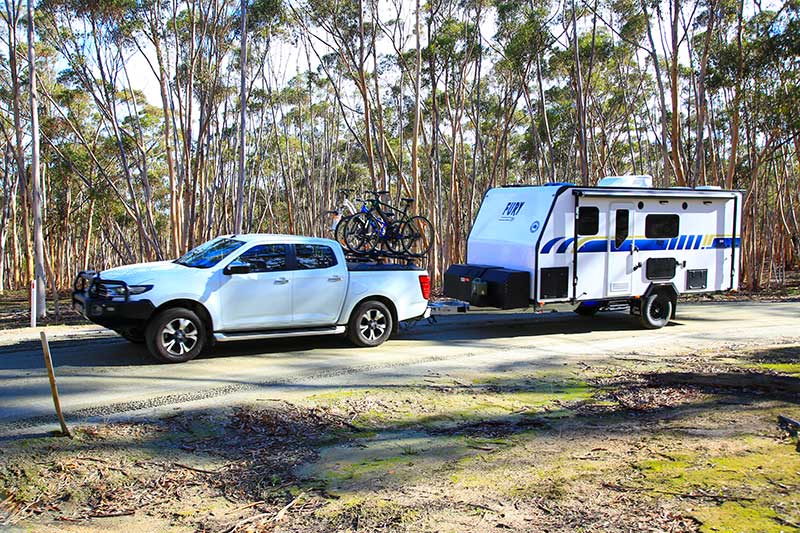
The first production Fury RV was forecast to be well within spec of their Pajero Sport. In the end, it weighed 2307kg Tare and had an ATM of 3000kg, an unladen ball weight of 199kg and a payload capacity of nearly 700kg. Weight-wise, it was perfect.
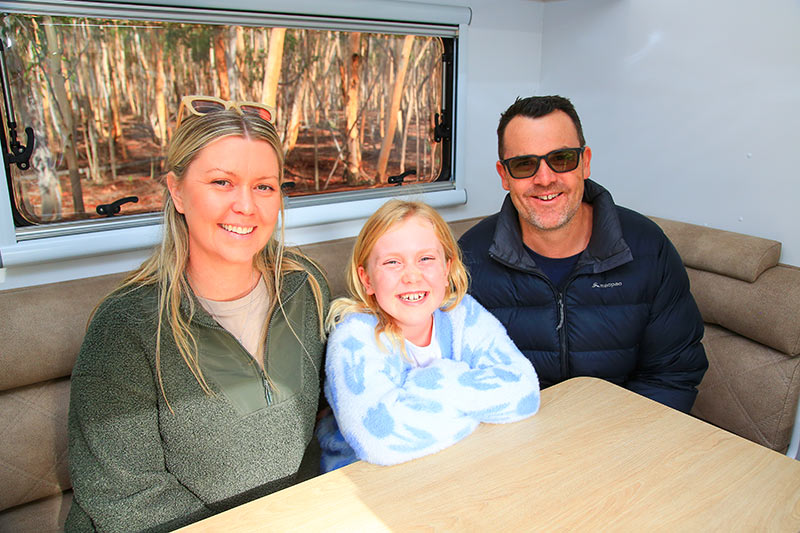
In the meantime, however, the couple decided to upgrade their tow vehicle, offloading the Pajero Sport in favour of a BT-50. As Tom said, the upgrade meant that their vehicle wouldn’t be constantly operating at the peak of its towing capacity, meaning less stress on the vehicle and peace of mind that they would always be within legal tolerances. It also allowed them to load up the tow vehicle with things like bikes, which would be pretty difficult from a Gross Combined Mass perspective if they stuck with the Paj. Not impossible, but tight. I must admit, I agree with Tom’s point of view.
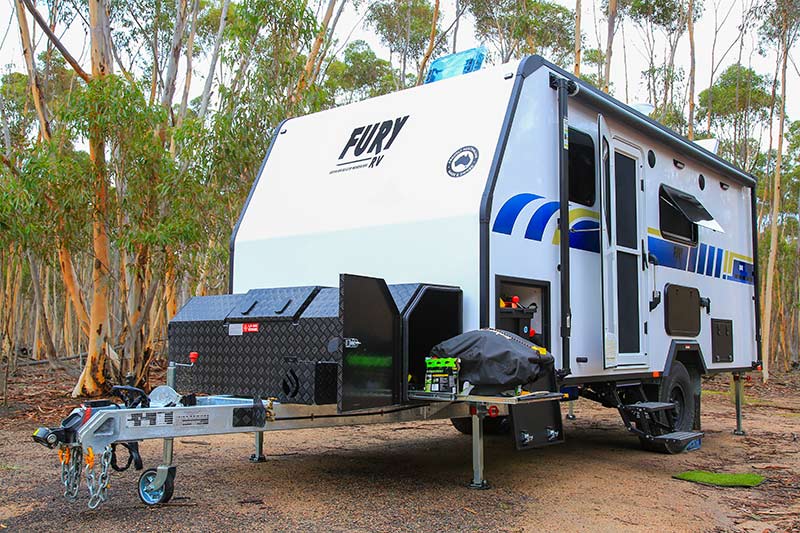
Built from fibreglass sandwich panels atop a 6in hot-dipped-galvanised RHS chassis, it’s equipped with independent trailing arm coil suspension as well as two 110L water tanks and a 110L grey water tank.
The overall external finish looks great. The powder-coated corner aluminium trim is done well, nothing appears flimsy or as though it will break – ultimately, you’d never know this was the first fibreglass sandwich panel van that Wonder Roo had built. All the gear is there, from a camera to a roll-out awning, side speakers, multiple storage lockers, a picnic table and a mounting point for a TV (not to mention nearby power and antenna connections).
You’ll note that the rear spare wheel isn’t fixed to a rear bar. Instead, it sits on a small steel ‘platform’ that protrudes from the chassis and is bolted to the rear wall of the van. Will future Fury RVs get a full aluminium bar complete with firewood box, jerry can holders and storage space? I’m not sure, but I’m willing to bet that if you wanted one, Wonder Roo would make it happen.
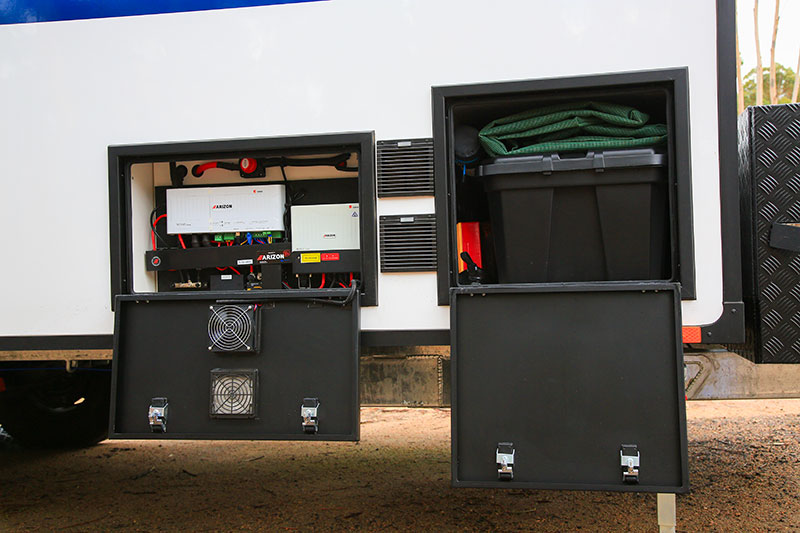 The 12V system is comprised of 460Ah worth of lithium batteries connected to 500W of rooftop solar, a 3000W Arizon inverter and an Arizon power management system. Should the couple need to increase their solar input, they can connect a portable panel to the Anderson plug at the drawbar.
FURY RV CUSTOMISATIONS
Being a smaller van, it was important to Tom and Kiara that they maximise internal living space – via a few clever ideas.
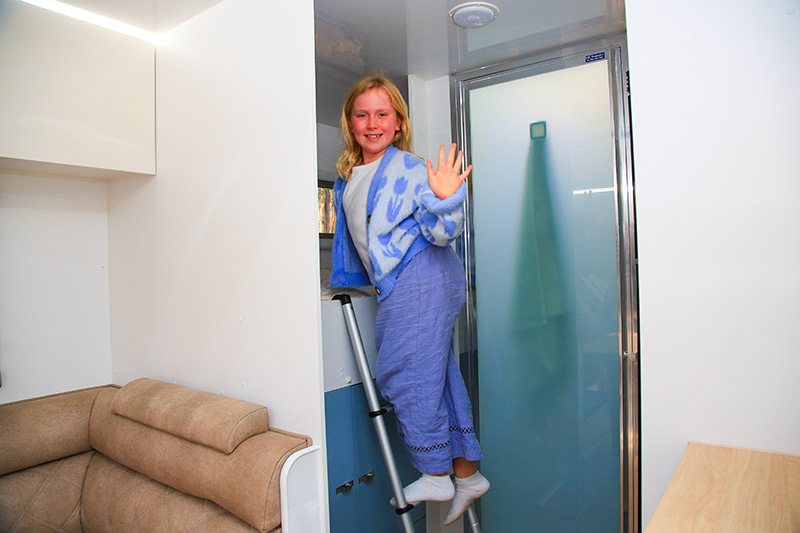
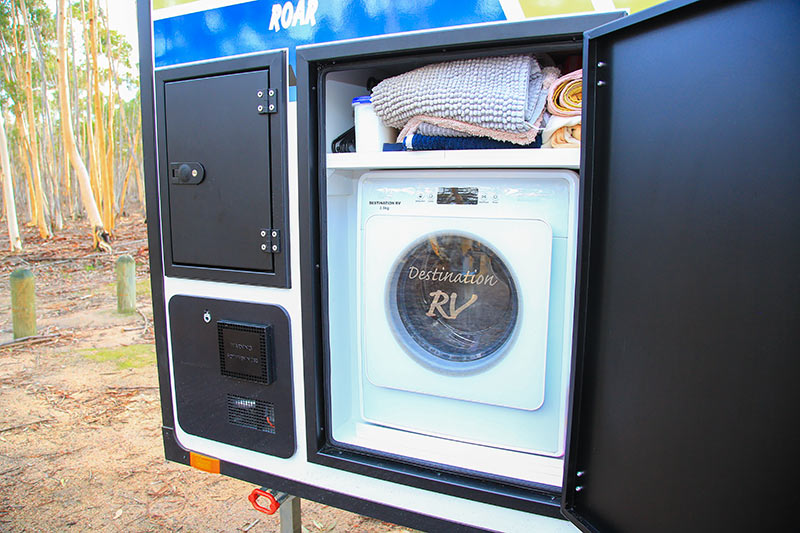
The offside of the van is home to a front-loader washing machine. Just open a locker door. But it’s a little more interesting than that. You see, this washing machine is actually positioned under the one and only bunk bed inside this van. Tom and Kiara have one child, so there was no need for additional bunks. This allowed them to locate not only the washing machine but an entire storage system underneath.
The rear bathroom might be a small space but because of Tom and Kiara’s ideas, it is very functional (not to mention attractive). You see, next to the toilet is a hatch where they can put their clothes ready to be washed. This hatch is accessible from the outside, right next to the washing machine, so when it’s time to do the washing, it couldn’t be easier.
Something else I really liked about the bathroom: a flip-up bench above the SJRV waterless, chemical-free toilet, which automatically heat-seals waste into hygienic bags. When it’s not needed, this bench folds flat against the rear wall, out of the way. Brilliant.
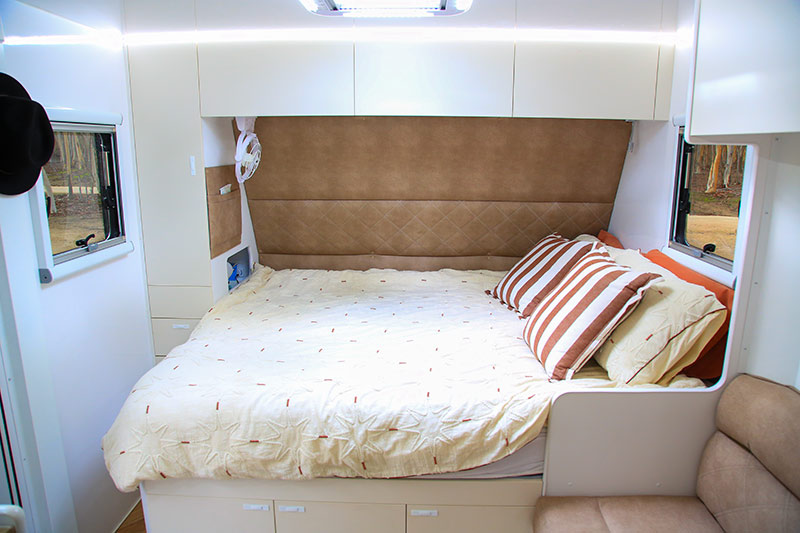
Unsurprisingly, the van has an east-west bed and I loved the lockers underneath – they would make accessing and organising the storage space beneath so much easier and logical in comparison to wrangling the bed base for access.
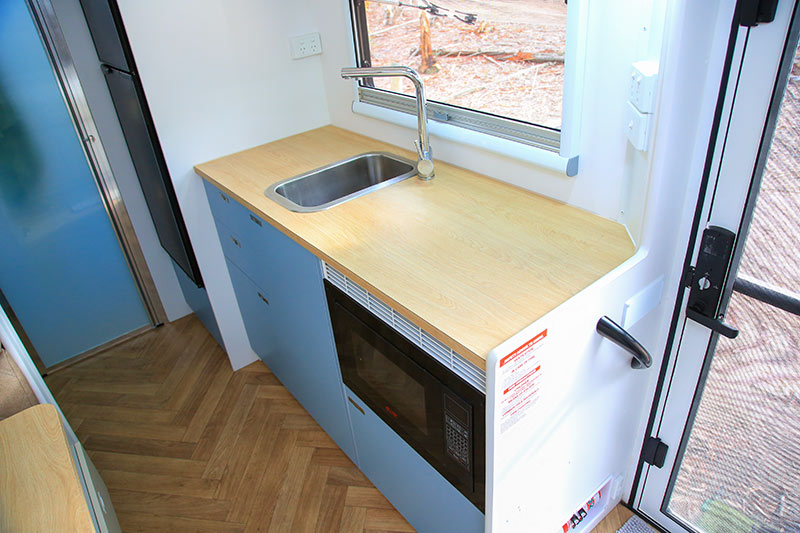
 When it comes to cooking, the van isn’t equipped with a typical gas cooktop, griller or oven. Instead, Tom and Kiara will use a portable induction hotplate or their Thermomix when they want to cook inside, and let’s not forget that they have a Swift Dluxx 23L flatbed microwave. They’ve also fitted a Weber Q to the slide-out tray within the storage unit on the drawbar.
From their perspective, why haul the weight of a full oven, griller and cooktop around the country when they didn’t have to? Between the van’s gas system and off-grid battery setup, they have all the options they need.
SUMMING UP
This 17ft 6in Fury RV Roar is a welcome addition to the market, at a time when the caravanning public is opting more and more for frameless construction using fibreglass sandwich panels capped with neat aluminium trim in lieu of traditional J-mould. Fewer joins and expansion gaps, better insulation properties and a seamless appearance.
 The input from Tom and Kiara really elevated the layout – the bunk setup is fantastic – and I have no doubt that this caravan will serve them well as they explore Australia in their own time and on their own terms.
It might not be the largest van in the caravan park, but it sure is an attractive, functional, robust unit that I would also be proud to own. Give Fury RV and Wonder Roo a look – I don’t think you’ll be disappointed.
FURY RV ROAR 17FT 6IN SPECS
Overall length: 7.9m
External body length: 5.4m
External width: 2.5m
Travel height: 3.2m
Internal height: 1.98m
Tare: 2307kg
GTM: 2700kg
ATM: 3000kg
Unladen ball weight: 199kg
Construction: Fibreglass sandwich panel with PET composite sandwich panel floor
Coupling: DO35
Chassis: 6in hot-dipped-galvanised
Suspension: Tuffride offroad independent trailing arm coil
Brakes: 12in electric
Wheels: 16in alloy
Fresh water: 2x110L
Grey water: 1x110L
External shower: No
Awning: Manual wind-out
Batteries: 456Ah lithium with Arizon power management system, 3000W inverter and digital display
Solar: 500W
Air-conditioner: NCE reverse-cycle
Gas: 2x9kg
Bike rack: No
Sway control: Yes
Washing machine: 3.5kg Destination front-loader
Cooking: Swift Dluxx two-in-one microwave
Refrigeration: 175L Sphere compressor
Fans: 1x12V bedroom fan; 1x12V bunk fan
Shower: Wall-mounted with hand-held option
Hot water: Suburban gas/electric
Heating: No – reverse cycle air-con only
Toilet: SJRV sealed bag
Lighting: LED
Entertainment: No TV as standard; sound system with internal and external speakers provided
Three-lid toolbox with jerry can holder; foldable benchtop above toilet; additional drawers; 3000kg suspension upgrade; 3000W inverter; increased battery capacity; jerry can holder; bed area fans; SJRV sealed bag toilet