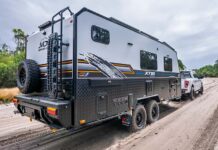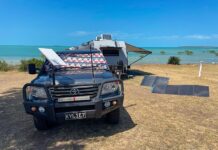

Ever heard of Vision RV? If the answer is no, it’s time to check out this manufacturer. While Vision RV is based in Queensland, the vans are built overseas to the vision, if you’ll pardon the pun, of company owner Chris Michel. He’s no stranger to the RV and 4×4 game. There’s few tracks in this country he hasn’t tackled, and he’s not afraid to take on a challenge – or to genuinely torture-test his vans. All in the name of product improvement, of course.
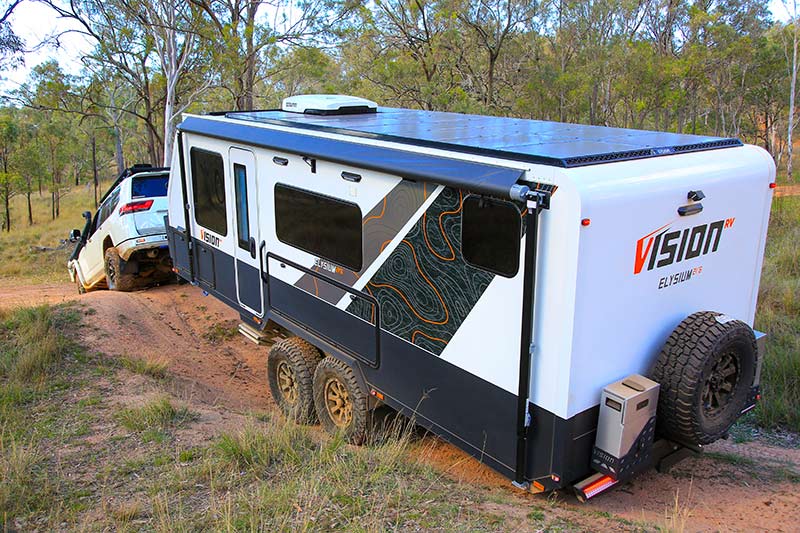
I was invited to a Vision RV muster, held at The Springs Creek 4×4 Park, Qld, in September. Vision customers were there, happy and camped up in their rigs, and Chris used the location as an opportunity to demonstrate the strength of his vans. In short: he hitched one of his newest vans, the Elysium 21.6 bunk van, to his 300 Series, and towed it through a 4WD course, including gullies, crests and tight corners. This is the same person who once gave Beer O’Clock Hill a crack with a 14ft Vision pop-top on the back, and if you don’t know what Beer O’Clock Hill is, the best advice is to Google it.
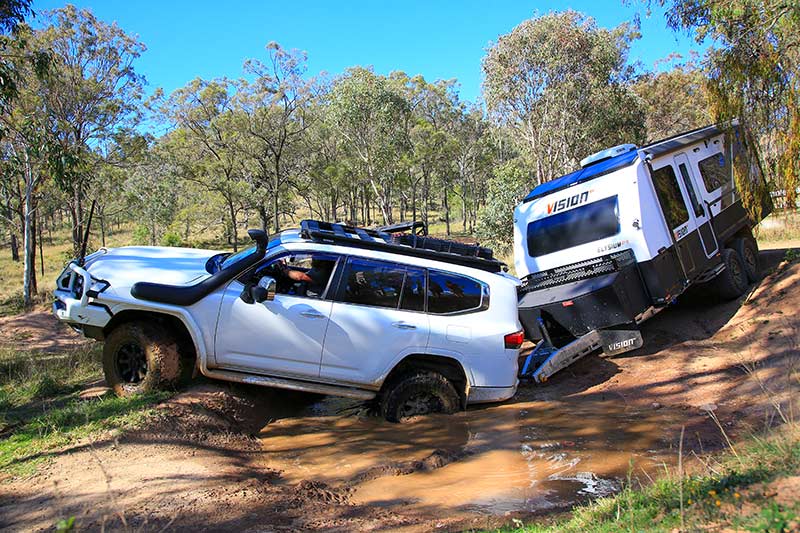 After watching the Elysium 21.6 take a pounding on the track, I was expecting something special when I finally had the chance to take a closer look…
BUILDING THE VISION RV
The van is built on a 6in hot-dipped-galvanised chassis with an aluminium sub-frame, and independent airbag suspension with twin ARB shock absorbers per wheel. Having seen this van in all sorts of off-camber action, the suspension is clearly well sorted. Incidentally, ventilated disc brakes are used for better heat dissipation and overall better performance.
The chassis is also fitted with rear recovery points, and it’s worth noting the chassis extension for the rear bar, which provides a better departure angle and space to mount accessories. The rear bar is equipped with a couple jerry can holders and a spare wheel, though you could option in a second spare.
 A quick story that speaks to this van’s pedigree. Chris Michel was on the Cape when his van did a wheel bearing. Clearly, not everyone travels with spare wheel bearings or has the ability to replace one, especially in a remote area. So, he needed a solution. The result: each wheel rolls on a fully replaceable stub axle. Provided you have a spare, swapping out the damaged for the new is a much more achievable DIY roadside task – and it can be done with ring spanners. It wouldn’t be fun… but you’d be relieved that you could get yourself going again.
The van’s structure is a composite fibreglass shell construction – very difficult to fault – finished with a lower waist of genuine Raptor applied by Vision’s paint team inside specialised spray-paint booths in the Baringa, Qld, factory. The walls are joined and bonded using aluminium extrusion, while all external hatches on the body of the van are fabricated from the same fibreglass sandwich panels as the walls, and appear to be very strong. Open the offside picnic table to reveal a multipurpose storage location. Here, you’ll find the switch for the fold-out entry step, a mixer with removable hand-held shower hose on a quick-release fitting (brilliant), power points, and a special Garmin control dock. This is part of the van’s Garmin Connect 50 digital switching system. The system is operated via dual tablets (one fixed, one portable) and it puts complete control of the van at your fingertips, from the lighting to the airbag suspension to the Gusto dust reduction system.
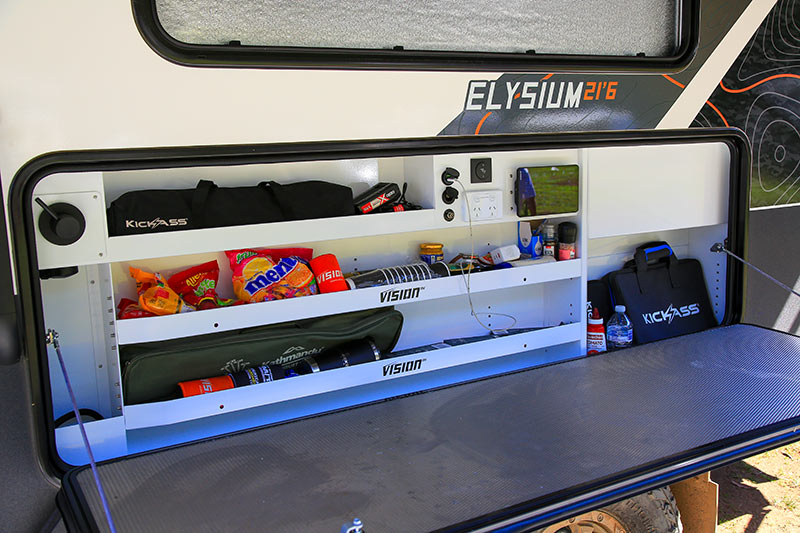 This system also tells the fore and aft pitch of the van as well as any east-west roll. Because you can place the portable display in the driver’s cab, you can ensure the van is perfectly level before you exit the car! Is it on a bit of a lean? Simply increase the psi in the relevant air-bag at the push of a button. The technical sophistication of this van is real – as is the attention detail, and the roof is a case in point.
First, every square inch of the roof real estate is covered in solar panels – 1760W worth, in fact. These panels are fitted to the roof using inhouse-built stainless steel brackets, connected to the roof via stainless bolts and nutserts. The only apertures are for the reverse-cycle air-conditioner and the solar cable, and I suspect if Chris could find a way to eliminate them, he would.
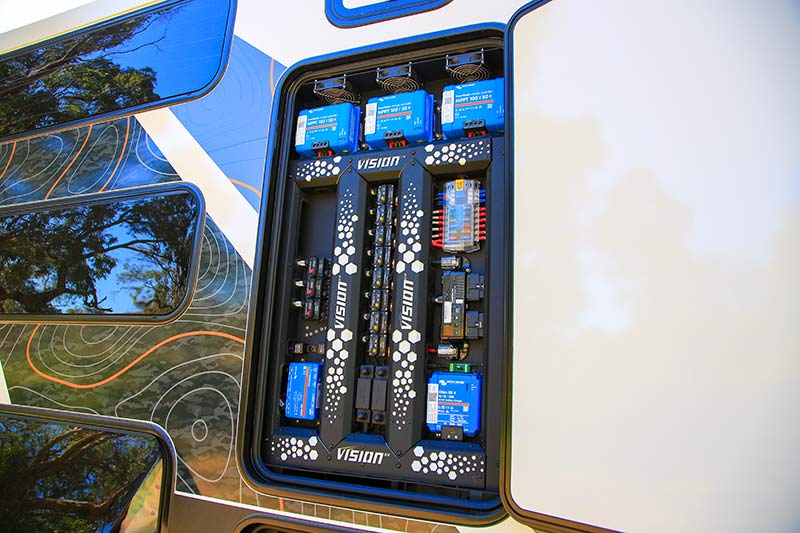
As for the rest of the electrical system, there’s a 920Ah lithium battery bank, along with Victron solar controllers and 50A DC-DC battery charger gear inside a fan-cooled offside locker. The detail in this locker is undeniable, with laser-cut aluminium added to the electrical conduits – it looks great.
 Let’s talk water. The Vision RV Elysium 21.6 has a generous 270L of onboard storage, as well as an 87L grey tank – of course, each tank beneath the van’s one-piece polypropylene ‘honeycomb’ floor is protected from road and track debris.
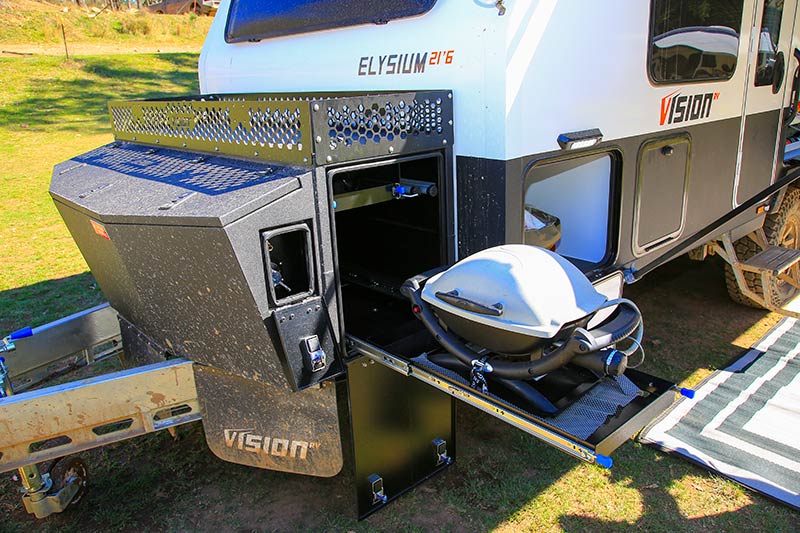
Up front, the van is equipped with a powder-coated storage box complete with a firewood tray, slide-outs either side with upper storage space, and something I particularly liked, a mixer and quick-release shower hose fitting either side of the storage box, giving the van three external water outlets: one behind the picnic table, and two within the front storage box.
Despite this van’s whopping 12V capacity, it isn’t ‘gas-less’ – Vision RV has fitted two 9kg gas cylinders housed within the A-frame box. New models, however, are gas-less but retain the ability to carry gas cylinders if desired.
Have I covered every external feature? Doubtful. There’s a lot to appreciate here, including the premium 3M decals with colour-shifting finish.
 As expected, the van isn’t a lightweight. In fact, our review van weighed in at 3045kg Tare, though its unladen ball weight was relatively light at 153kg. The standard ATM, however, is 3500kg. Is this a drawback? Not necessarily – it depends on how you pack. But it also depends on your tow vehicle, as the Elysium 21.6 is engineered already for a 4500kg ATM upgrade.
NO TIMBER HERE
Stepping inside, the ‘timber-less’ nature of this van really comes to the fore. Even the doors to the cabinets are a lightweight ‘honeycomb’ material, rather than ply, while the shelving inside is powder-coated aluminium sheeting, folded and laser-cut. I couldn’t fault it. The fit and finish under the sink, for example, is top-notch. The plumbing runs through neatly punched holes in the shelving, with no gigantic gobs of silastic to be found. Hallelujah.
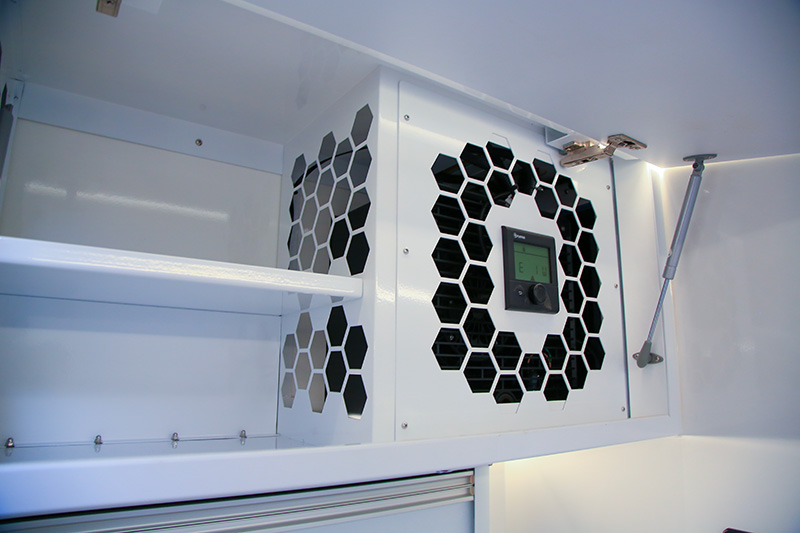 As for the benchtop, unsurprisingly, there’s no timber, MDF or laminate to be found. Instead, Vision RV opted for a solid acrylic – it provides a premium look and feel, and its hard-wearing finish makes it suitable to life on the road.
In terms of appliances, the kitchen has a massive 274L compressor fridge-freezer and a three-in-one microwave/air-fryer/griller. A couple of portable induction cooktop are provided, too, which ultimately means loads of kitchen bench space – not having a fixed cooktop really makes a difference.
The stitched-leather dinette comes with 12V and 240V points in the leg area, meaning you can manage your cables effectively while perusing your devices. The fixed Garmin display is within arm’s reach, too.
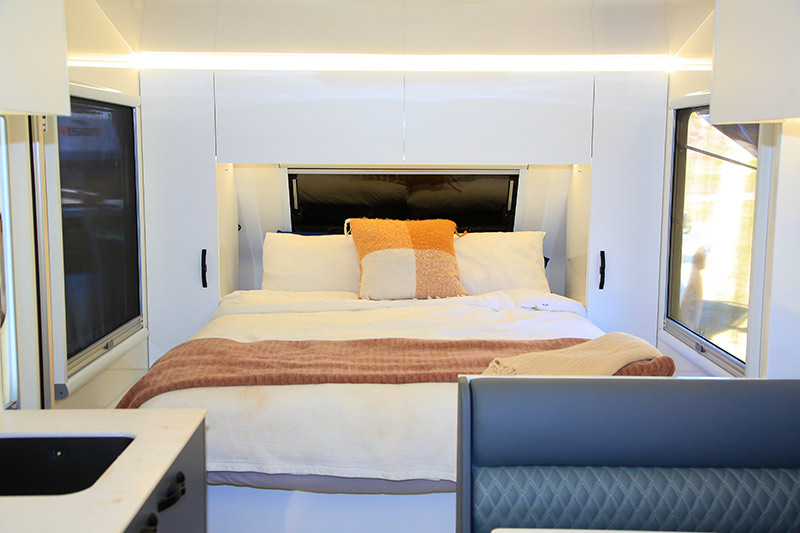 A queen-size bed sits in the nose of the van, below a front window with a stoneguard. Front windows aren’t so common these days, but I still like them. The bedroom also gets a couple of 12V fans, and we all know how welcome they are.
As mentioned, this is a bunk van. Three of them are fitted to the offside in the rear of the van. Yes, the bed bases are aluminium – not timber. Of course, each bed has power points and a fan – the kids have nothing to complain about here. A front-loader washing machine and cabinets fill out the space between the bunks and the bathroom.
The bathroom has a composting toilet that uses Vision RV’s zero-smell composting toilet system with a separately plumbed 16L urine tank – a practical, low-maintenance solution for off-grid living.
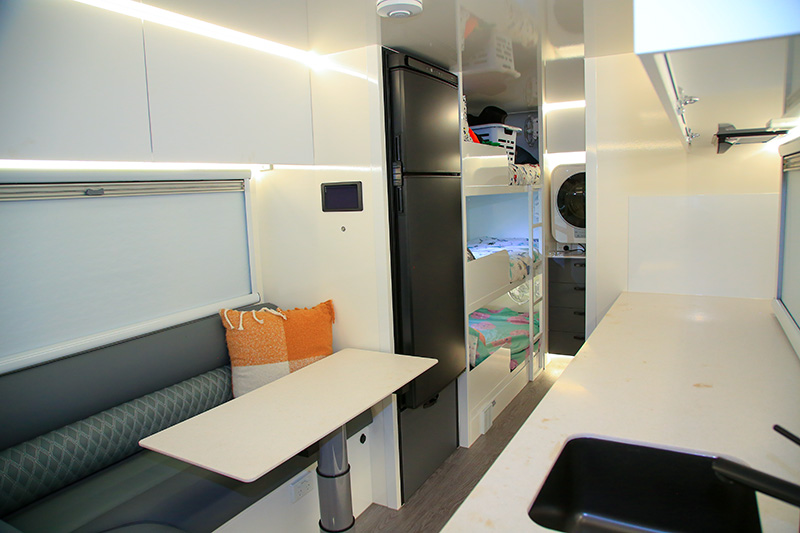 Have I covered everything? Not by a long shot. There’s the diesel-fired Truma Combi water and space heater, dimmable lighting, auto-levelling of the van via the airbag controls (either manual or wireless) and of course the ability to tap into the onboard compressor to top-up your tyres. I could go on…
SUMMING UP
This is one of the most complete vans I have seen in some time. I think a lot of it comes down to Chris Michel’s background and his love of the outdoor lifestyle. He’s tested his products in the only way he knows how – hard – and over the years, he’s implemented features and solutions that many manufacturers would never have considered.
During the muster, I spoke to a number of Vision RV owners. They each loved their van and had nothing but praise for the after sale service they’ve received. Chris is the kind of bloke who will always do his best to help out a good person, customers included. I came away from the muster with renewed appreciation for the work happening up north, and I’ll have one eye firmly on this brand in the future.
THE SCORE
FIT AND FINISH – 
LAYOUT – 
INNOVATION –
HITS & MISSES
VISION RV ELYSIUM 21.6 SPECS
Overall length: 9.17m
External body length: 6.57m
External width: 2.37
Travel height: 3.02
Internal height: 2m
Tare: 3045kg
GTM: 4347kg
ATM: 4500kg (3500kg is standard)
Unladen ball weight: 153kg
Construction: Fibreglass sandwich panel with ‘honeycomb’ floor
Coupling: DO35/DO45 (depending on ATM)
Chassis: 6in hot-dipped-galvanised with aluminium sub-frame
Suspension: Independent airbag
Brakes: 12in electric
Wheels: 17in alloy
Fresh water: 270L with integrated water management manifold
Grey water: 87L
Shower: Yes – multiple outlets with portable shower hose
Awning: Roll-out
Battery: 920Ah lithium with 3000W/120A Victorn inverter/charger
Solar: 1760W
Air-conditioner: Reverse-cycle
Gas: 2x9kg
Bike rack: Optional
Kitchen: Yes, with portable induction hotplate
Sway control: No
Cooking: Electric induction
Refrigeration: 274L compressor
Microwave: NCE 3-in-1 (microwave, air-fryer and griller)
Shower: Hand-held
Heating: Truma Combi diesel water/space heater
Toilet: Compositing with separate 14L urine holding tank
Washing machine: Front-loader
Lighting: LED
4500kg ATM upgrade
$200,980
From $199,990