
At the start of 2026, OPUS launched a series of hybrid vans known as the Expedition series, available in 16 and 17ft formats. The 17-footer is the family variant, known as the Expedition Max, while the subject of this review is the 16ft Expedition Pro, available only as a couple’s van. Both, however, are available as pop-tops.
If you’re unfamiliar with OPUS, you’re probably at least familiar with the inflatable OP camper. Press a button, and the camper’s ‘air beams’ inflate, pulling the tent section taught. It’s a sight to behold.
But where does the Expedition sit within the OPUS range? While the OP continues to be a popular seller, OPUS hopes to appeal to families and couples who want a full caravan with all, or most, of the trimmings, without the jaw-dropping price tag. These are value vans. The OPUS Expedition Pro seen here, for example, comes in at $69,990.
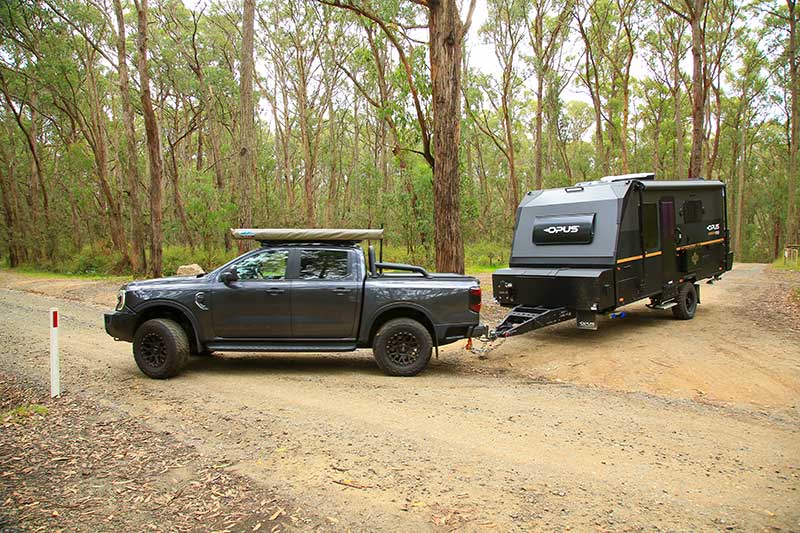 The guys at OPUS use these vans themselves – they’ve been subjected to numerous R&D trips. They also look good, with distinctive styling and a high stance on the road, so let’s step inside the 16ft OPUS Expedition Pro and poke around.
OPUS EXPEDITION PRO LAYOUT
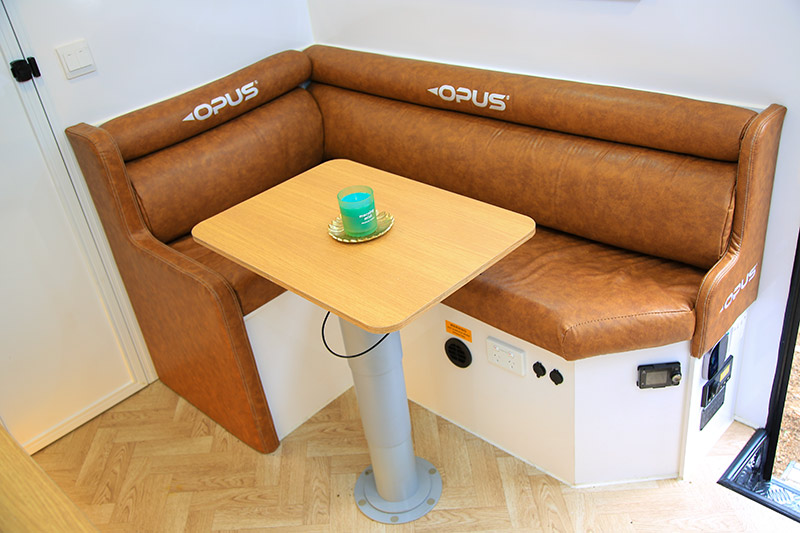
I give this van points for its layout. It’s compact, sure, but that’s the point. Small, logically arranged and practical vans are my preference. This layout, therefore, was right in my wheelhouse. It contains a north-south bed, an L-shaped dinette to the nearside, behind the forward entrance, a kitchen opposite, and a narrow bathroom across the rear.
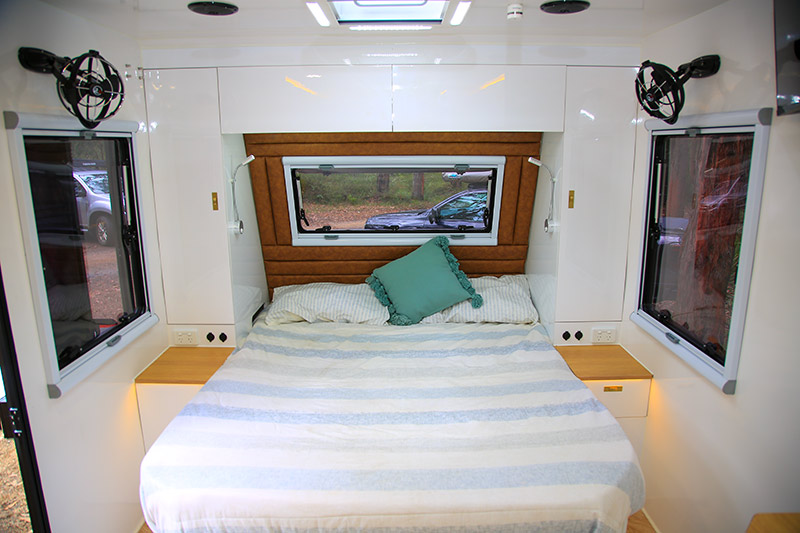 OPUS is able to offer customisation within reason. For example, if you’d like to re-configure the kitchen cabinetry, or perhaps run the bed east-west in order to open up the layout, this manufacturer is willing to talk.
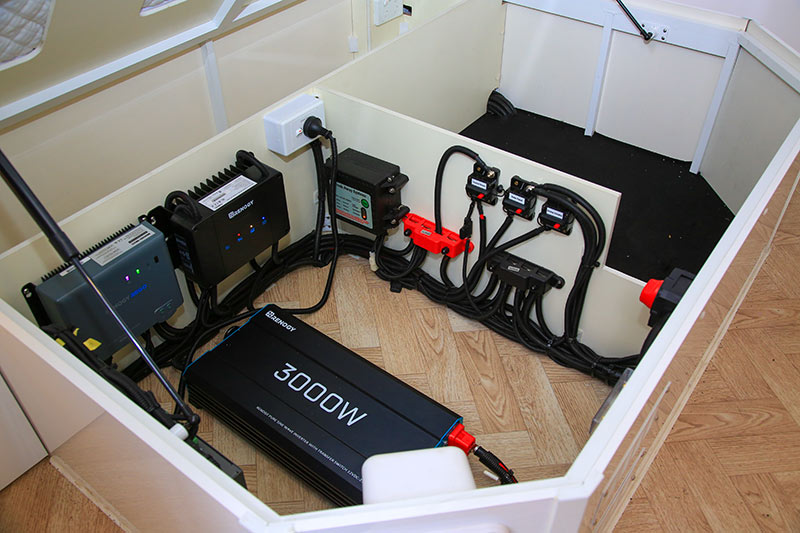
There are lots of little touches to appreciate. In the bedroom, you’ll find both a cigarette-style and USB point, as well as a 240V point, either side of the bed. The front window is a winner too – they’re so infrequently fitted to vans these days. The mattress lifts on gas struts to reveal a sectioned storage area, with the 3000W Renogy inverter, mains charger and solar regulator mounted to one side, and open storage space to the other.
 The van is powered by 600Ah of lithium batteries, mounted under the dinette and vented to the outside, that are charged by 800W of solar on the roof. The battery capacity can even be upgraded to 900Ah… though that seems excessive.
The off-grid capabilities of this van are augmented by a decent fresh water carrying capacity – 240L, to be exact, more than what many larger vans offer. The grey water tank, however, is on the smaller side at 70L.
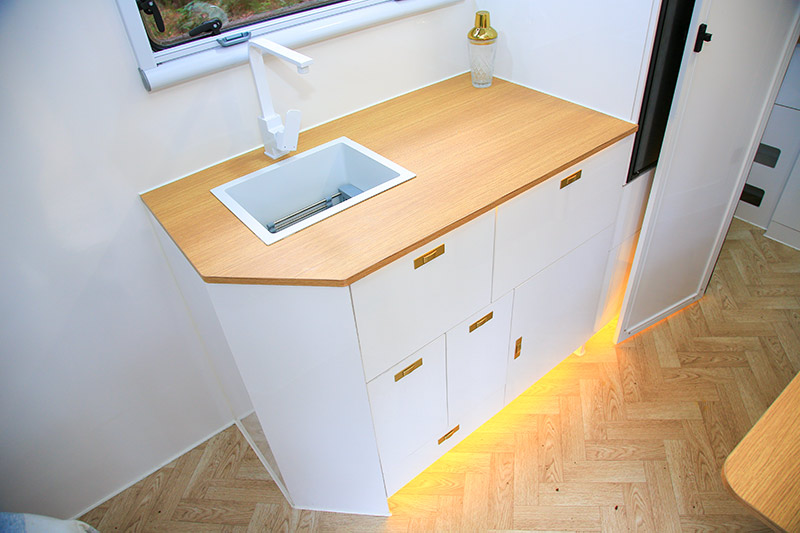
 The kitchen contains a small sink (minus a draining board), hot water courtesy of the Fogatti instant hot water system, a 130L compressor fridge-freezer and a microwave above. The fridge can be upgraded to a much larger 200L unit; however, that would mean losing the drawer storage underneath. No permanent cooktop or oven is provided, though, the idea being that the owner would use a portable induction hotplate when cooking inside.
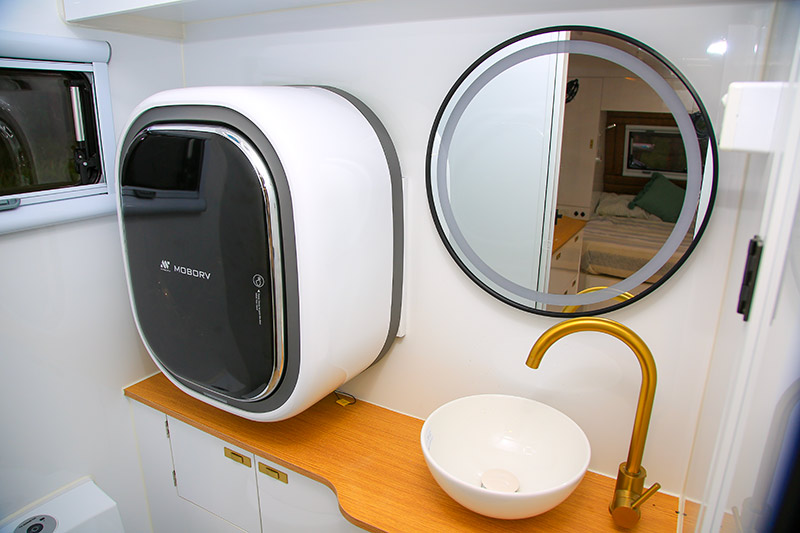 That leaves the bathroom. While the bathroom, and the door, are quite narrow, everything is here that you’ll need, including an over-sized shower. I certainly didn’t expect a shower of this size in this little 16-footer! It’s actually a good little space that includes an anti-fog mirror, a cassette toilet, storage space… and even a front-loader washing machine. That washing machine, though, is an option. That said, it looks at home here, despite the small space.
Other internal appliances include a Dometic Freshjet reverse-cycle air-conditioner, 12V fans in the bedroom, LED strip lighting above the overhead lockers, and a diesel heater. The controller is mounted to the base of the dinette, since the heater is located underneath the seats, but if I were ordering this van, I’d ask for the controller to be moved within arm’s reach of the bed.
EXTERNAL STRENGTHS
The OPUS Expedition series is built on a galvanised 6in chassis with a gooseneck drawbar – this keeps the coupling within legal height tolerances, since the van sits quite high. The chassis has been painted with a chip-resistant protection material similar to Raptor coating, while OPUS has fitted independent trailing arm coil suspension with Pedders shock absorbers that are mounted perpendicular to the ground for optimum dampening.
 It’s framed with aluminium and clad with composite aluminium sheeting – the laser-etched trim in lieu of J-moulds looks great too.
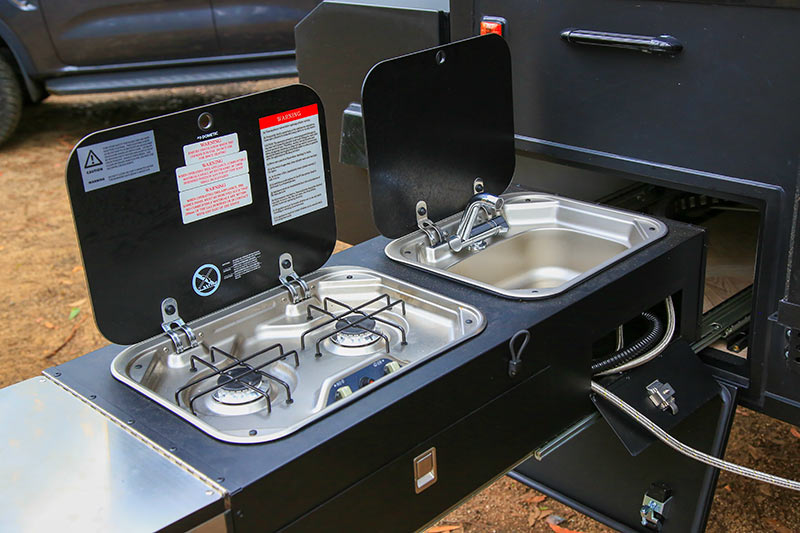
As mentioned, there’s no fixed internal kitchen. That’s because OPUS has given this van a slide-out with two gas burners and sink with hot and cold water. The water lines remain permanently fixed to the kitchen; however, the gas still needs to be connected to the gas bayonet. The bayonet, by the way, is mounted in such a way that it would be unlikely to be damaged, rather than being fixed to a flap of checkerplate hanging off the chassis – vastly better.
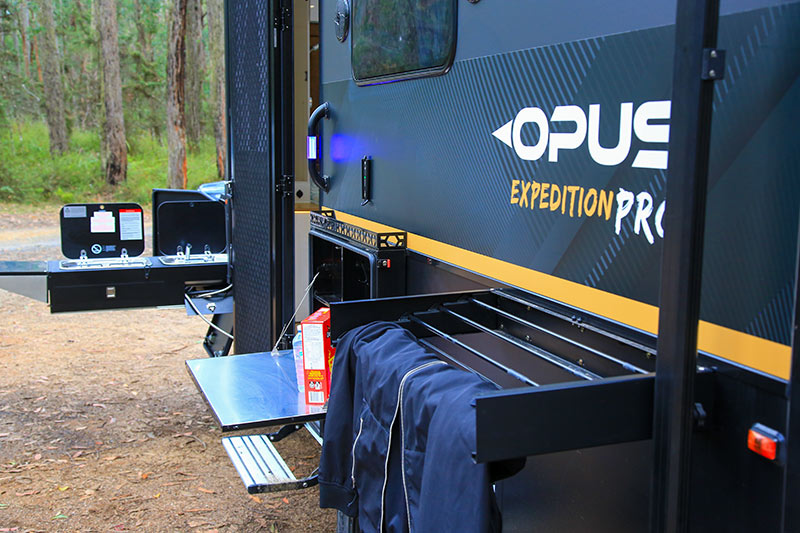 The nearside contains a full awning, a locker with a slide-out tray, a storage module with picnic table, and my personal favourite: a built-in clothesline that takes less than a moment to set-up. It isn’t a new feature – I’ve seen them on vans before, but very infrequently. Apparently, there was internal debate at OPUS about the best position for the clothesline, with some advocating for the offside. The nearside won, though, based on the fact it allows you to still hang out your clothes in inclement weather by simply deploying the awning.
At the rear is a powder-coated aluminium bar with storage for longer items such as camp chairs or fishing roads. There are two lockable jerry can holders, a spare wheel and a firewood box. You could opt for a second spare, but that would mean losing the firewood box.
The offside contains an external shower – with a difference. Our review van had an optional rail bolted to the side to accept an ensuite tent. It seem unlikely that you’d need a proper ensuite tent given the internal shower, but it’s good to know one is available.
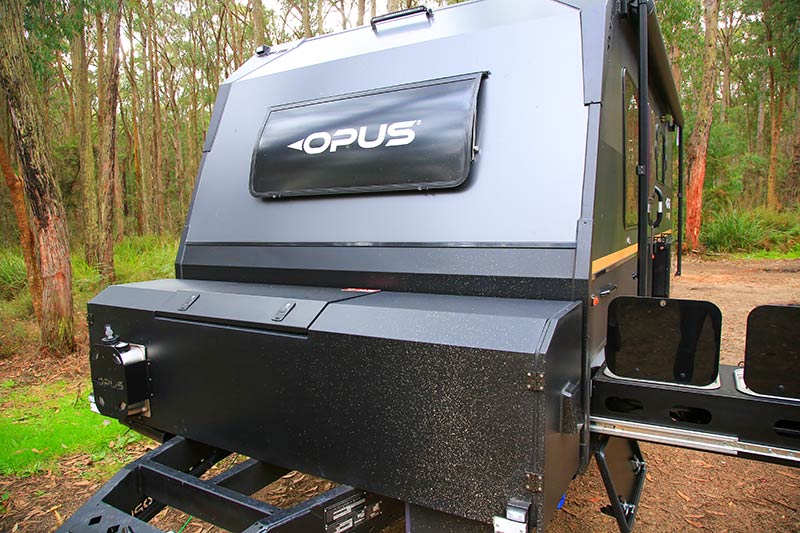 Bolted to the drawbar is a large storage box containing storage space for two 9kg gas cylinders and two slide-outs to either side. The nearside tray is ready to accept a 50L portable fridge – an Anderson and cigarette-style socket are included in this space to power a fridge – but you can opt for a tray to suit a fridge up to 95L in size. The door to this space offers filtered ventilation.
Like all vans from OPUS, the Expedition Pro is built as an offroader and to that end, it’s equipped with a DO35 coupling. No front stoneguard comes as standard though – at a minimum, I’d use a Stone Stomper or similar when heading offroad.
 What does all this weigh? Actually, the Tare isn’t too bad at 2354kg. The payload capacity of the OPUS Expedition (646kg) is decent too. OPUS has saved a small amount of weight by cutting out non-structural and slightly hidden sections of cabinetry in the bedside wardrobes, as well as the ply beneath the mattress and the dinette. Every kilogram counts, after all.
SUMMING UP
Over the years, I’ve developed the impression that OPUS is a solutions-focussed manufacturer. While there are a few minor aesthetic areas where the fit and finish inside could be better, the overall package is highly appealing, with plenty of inclusions designed to simplify life on the road. For me, this 16ft OPUS Expedition Pro is the perfect size, and I don’t doubt the strength of the build.
It has a great power system, it’s small and nimble, and it’d make a terrific base for your explorations of Australia, whether we’re talking the bush, the outback or the coast.
THE SCORE
FIT AND FINISH – 
LAYOUT – 
INNOVATION –
HITS & MISSES
- Despite its compact dimensions, this van offers a lot of liveability
- Built for off-grid living, with a decent power system and fresh water capacity
- Overall, an appealing package at an excellent price
- Could the drawbar be fitted with a stoneguard from factory?
- A few small areas internally that could have been finished better
COMPLETE SPECS
Overall length: 7.49m
External body length: 5m
External width: 2.45m
Travel height: 3.2m
Internal height: 2m
Tare: 2354kg
GTM: 2700kg
ATM: 3000kg
Unladen ball weight: 235kg
Frame: Aluminium
Cladding: Composite aluminium
Coupling: DO35
Chassis: 6in galvanised with gooseneck drawbar
Suspension: Independent coil with Pedders shocks
Brakes: 12in electric
Wheels: 16in alloy
Fresh water: 2x120L
Grey water: 1x70L
Shower: Yes (ensuite tent available)
Awning: Manual wind-out
Battery: 600Ah lithium with Renogy battery management system, 3000W inverter and mains charger
Solar: 800W
Air-conditioner: Dometic Freshjet reverse-cycle
Gas: 2x9kg
Bike rack: No
Sway control: No
Cooking: None (external kitchen only)
Refrigeration: 130L compressor
Microwave: Yes
Shower: Hand-held
Heating: Diesel
Toilet: Cassette
Washing machine: Front-loader
Lighting: LED
Entertainment: Flatscreen TV; sound system with internal and external speakers
Front-loader washing machine; ensuite tent rail
RRP: $69,990