
OPUS is probably best known for its ‘inflatable’ camper, the trailer known as the OP series. With its ‘air beams’ to keep the canvas taught, it sets up in minutes and makes one heck of a statement to passersby and caravan-park lookiloos. However, the company has built hybrid campers and full caravans before, though the OP camper range has been its bread and butter for many years.
But things are changing at OPUS. Naturally, the OP will continue to stand front and centre in the overall lineup, but the company has just released a range of sub-18ft hybrid caravans for couples and families. It’s called the Expedition and it’s available in either 17ft or 16ft variants.
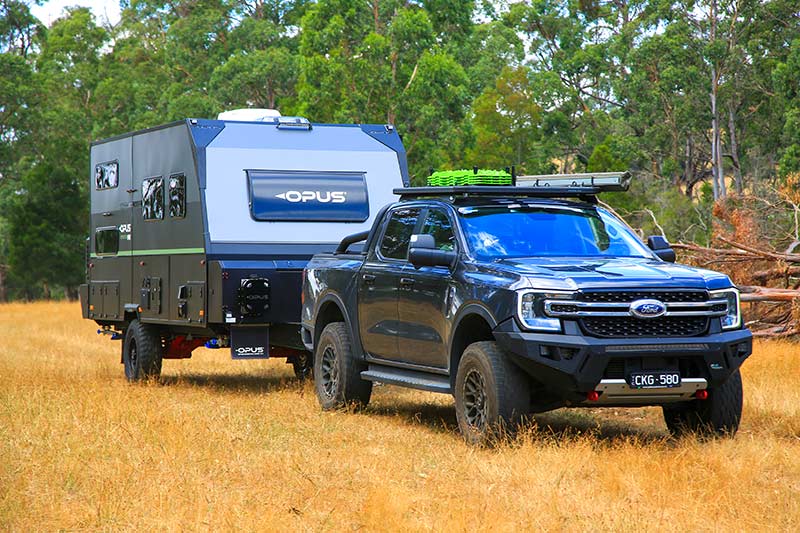 However, it’s important to note that the 17-footer is exclusively a family van known as the Expedition Max, while the 16-footer is the couple’s van, known as the Expedition Pro. Both models are also available in pop-top configuration with electric roof.
With these vans fresh off the production line, we were given the chance to check out the 17ft Expedition Max.
FIRST OPUS ITS KIND
Our review van was the very first of its kind. They are built overseas to Australian spec, and while it brings a lot to the table, with this being the first off the production line, there were still a few tweaks that OPUS was considering.
The appeal of this van lies partially in its price. From $69,500 (plus on-road costs) at the time of writing, it truly deserves a good, hard look.
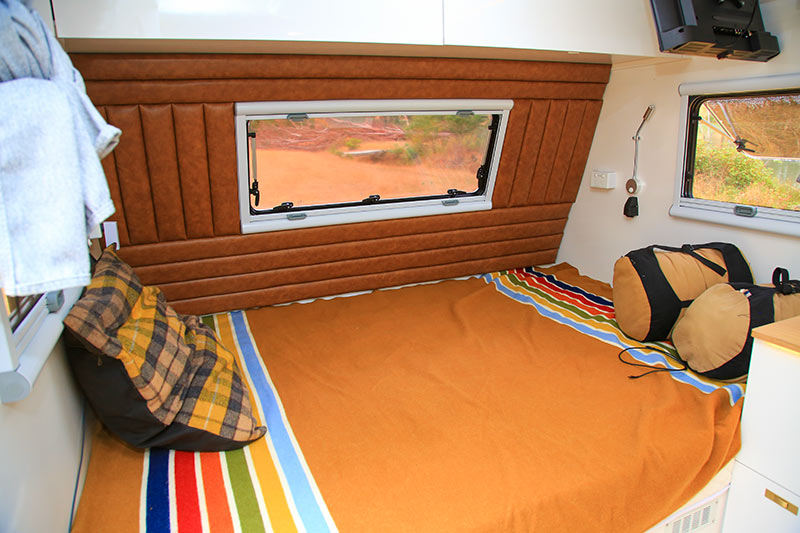 The Expedition Max employs that time-honoured way of maximising internal space: an east-west bed up front. Frankly, a north-south bed wouldn’t work in this space, at least not without forgoing the rear bunks and nearside ensuite. Because, you see, that’s the real trick of this layout: it packages the features and the layout of larger vans (in particular a rear kids’ room and seperate side bathroom) into smaller dimensions, and it works.
A couple observations: the layout necessitates a smaller bench-style dinette that would ideally suit two people, as well as a smaller kitchen. Coupled with the east-west orientation of the bed, the layout becomes surprisingly spacious. I noticed both a 12V and 240V powerpoint in the leg area of the dinette – an absolute must.
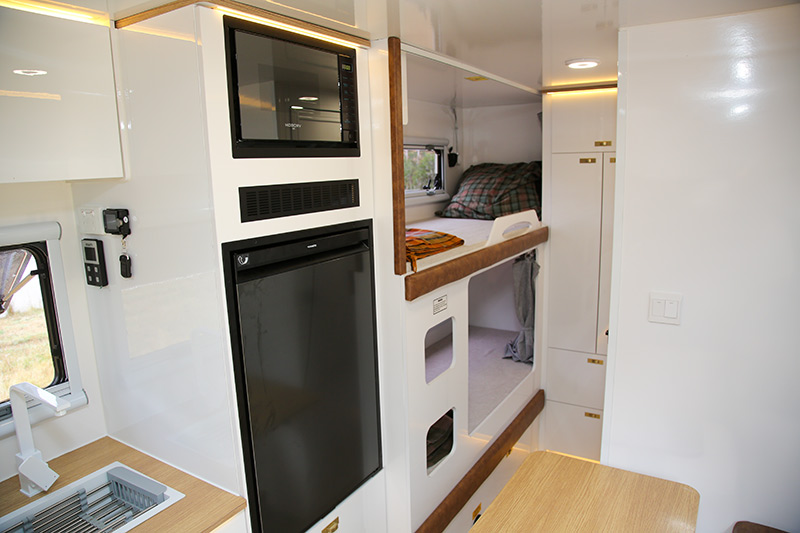 I mentioned that OPUS would be tweaking future production versions of this van. One such tweak will be to the height of the dinette lounge – shorter people would find the height of the lounge in our review unit slightly excessive.
The front bed setup includes a couple of overhead lockers, a reading light, 240V and 12V point either side, so depending on which end you choose for your pillow, you’ll be set for light and power. However, if OPUS placed the same on the offside, near the leading edge of the kitchen bench, the person sleeping on the outside would have a way to easily charge their device while perusing from bed. A single 12V fan is included too.
Though I mentioned that the kitchen was on the smaller side (due to everything else inside this van), that has not limited its functionality. There is still some bench space… and that’s down to the fact that the OPUS Expedition Max does not come standard with internal cooking appliances. Instead, the Expedition Max is equipped with an external slide-out Dometic kitchen with dual gas burners and hot and cold water – a Fogatti instant HWS is fitted.
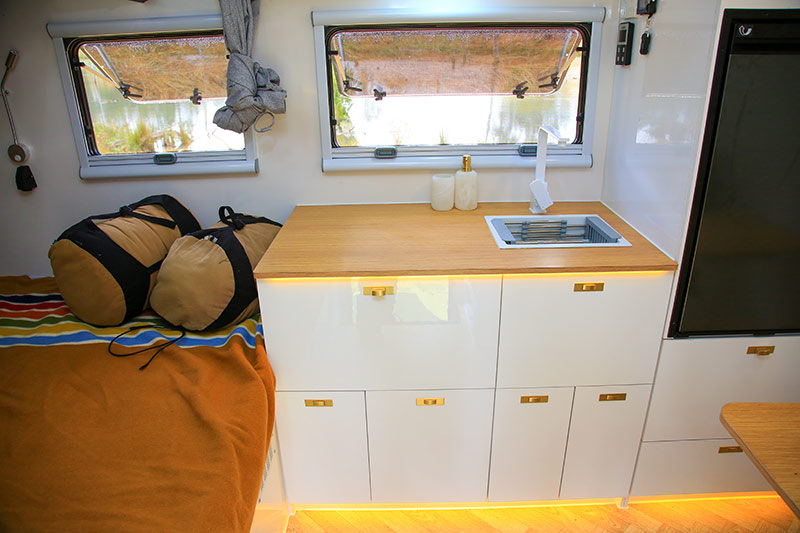 However, there is nothing stopping you from using a portable induction hotplate inside, which is the trend at the moment, given the generous onboard DC power supply. Alternatively, you could option in a permanent induction hotplate. The van comes as standard with 600Ah of lithium batteries (which can be extended to 900Ah overall), 800W worth of rooftop solar, a 3000W inverter, a Renogy One Core power management system, and a 50A AC and 50A DC-DC charger. It’s a decent system which should allow you to run the Dometic Freshjet air-conditioner away from mains, not to mention the 130L Dometic compressor fridge. Personally, I wondered if the fridge was large enough for a family; however, as I discovered, customers can choose to omit the pot drawer beneath to make space for a larger fridge. However, that’s not possible in the pop-top variant of this van.
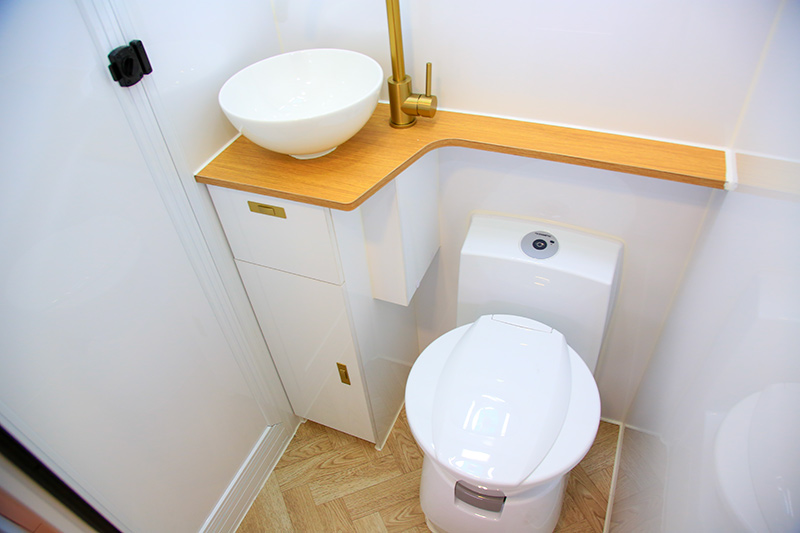 In the rear is the aforementioned bathroom and kids’ room. I liked that the bunks were a realistic length for teenagers, complete with a light, charging point and 12V fan, and that you can even have three bunks if you need. The wardrobe space is generous, too. Another observation: usually, the kids’ room is cordoned from the main living quarters by a curtain or sliding door. In this case, though, OPUS has instead given each bunk its own curtain. Everyone still has some privacy, but without a large curtain or door interrupting the flow of the layout.
Now, here’s where I believe some aesthetic improvements could be made: first, the three hinges to the bathroom door seemed unnecessarily bulky and obvious, and the ‘centre’ hinge wasn’t placed in the centre. Both of the aluminium-framed doors to the bathroom and separate shower cubicle, while functional, appeared finished to a lesser standard than the rest of the van. But knowing OPUS as I do, I suspect these items will be improved in the near future.
Overall, I think this layout pack a lot of value into otherwise compact dimensions – it even contains a Fusion sound system and a 24in flatscreen TV.
AROUND THE OUTSIDE
The Expedition Max is built atop a hot-dipped-galvanised 6in RHS chassis. Because the van rides quite high (requiring a double entry step), the A-frame tapers downward to keep the DO35 coupling within legal height tolerances.
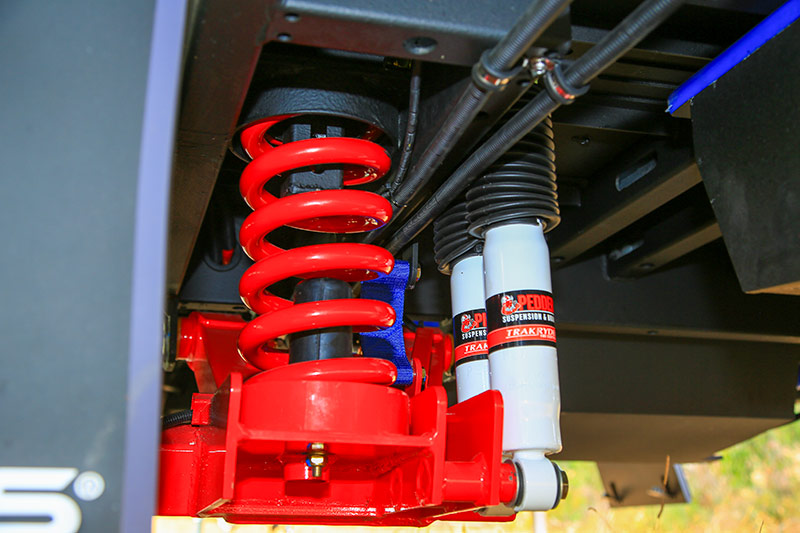
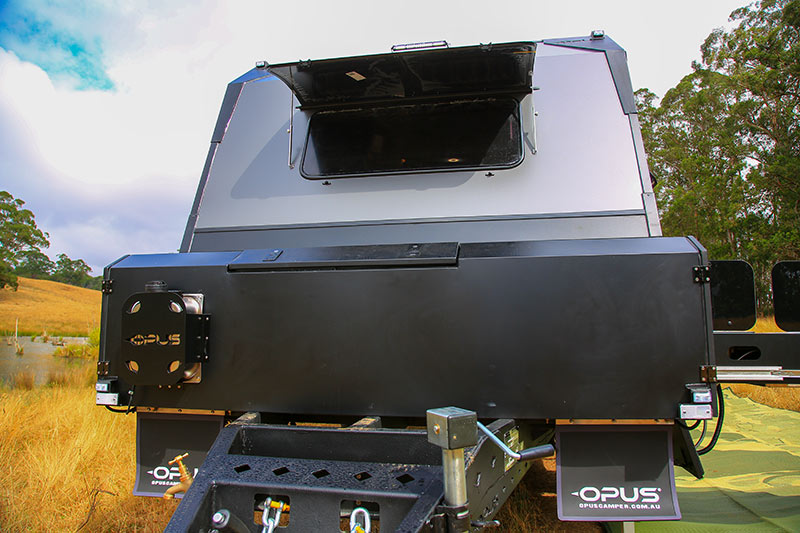 Being an offroad-capable caravan, it’s fitted with independent trailing arm coil suspension with Pedders shock absorbers mounted vertically – OPUS feels the vertical orientation provides better offroad performance, since the shock absorption occurs perpendicular to the ground. The water supply comes in the form of two 120L freshwater tanks, as well as one 70L grey tank. The van also comes pre-wired for Starlink.
 The self-supporting Dometic slide-out kitchen sits just out from underneath the roll-out awning – simply connect the gas line to the chassis-mounted bayonet, and screw on the water lines. I would, however, carry a portable induction cooktop for use inside during inclement weather.
There’s a storage box on the A-frame, containing a slide-out that would accommodate a portable fridge on the nearside, and general storage on the offside. The OPUS Expedition Max is also equipped with a substantial rear bar complete with storage space, jerry can holders, a firewood box, and of course a spare wheel. A reversing camera is also fitted to the rear wall. The metal plating replacing the traditional J-moulds looks great too.
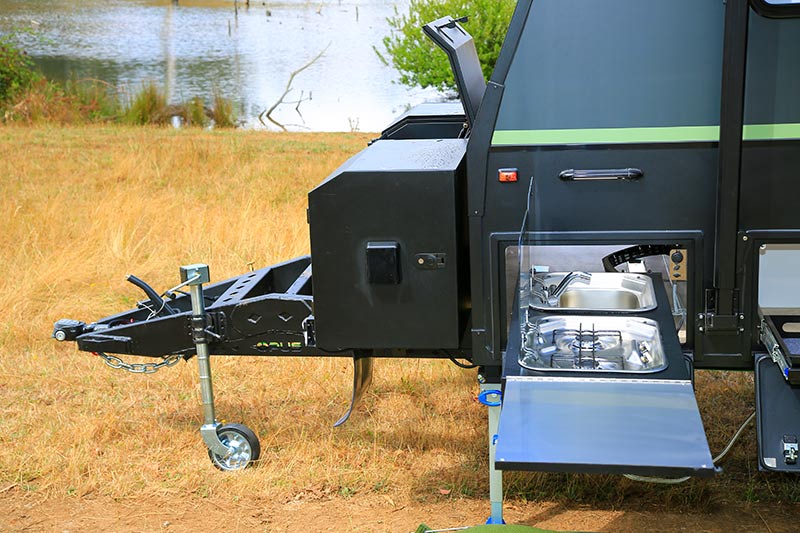 OPUS has riveted the diesel tank for the onboard heater to the front of this storage box, behind a piece of folded aluminium for protection.
Yet another slide-out tray, just aft of the kitchen, is provided – the perfect place to store a portable lithium battery, perhaps.
Framed in aluminium, with aluminium cladding and special ‘honeycomb’ floor and roof sections, no timber is used in the essential structure of the van.
It weighed in at 2475kg Tare, with an ATM of 3000kg, making the OPUS Expedition Max a suitable proposition for many mid-sized 4WDs – though you’d want to keep an eye on the ball weight in such a scenario since it’s 260kg unladen.
SUMMING UP
It’s great to see OPUS continuing to expand its range and build on the success of the OP camper. The Expedition Max certainly presents as a neat and tidy unit and from a pricing perspective, it absolutely hits the mark. A fully featured caravan that also looks the part for about $70K? In today’s market, that’s pretty good.
It uses good-quality components, such as the Renogy equipment, and the 12V system is fairly generous. Vans such as this intrigue me. It’s small – which I see as a benefit – but that doesn’t mean it’s missing anything. The only question is, do you prefer it in hardtop or pop-top configuration?
THE SCORE
FIT AND FINISH – 
LAYOUT – 
INNOVATION –
HITS & MISSES
- Value for money – it’s a lot of van with a decent power system for a good price
- A great layout in an otherwise compact caravan
- OPUS has even used plastic collars to finish off cabin entry/exit points for plumbing
- The hinges to the bathroom door seemed out of place in this van
- The dinette seat sits quite high, though that’s already been noted by OPUS for revision
17FT OPUS EXPEDITION MAX SPECS
Overall length: 7.66m
External body length: 5.1m
External width: 2.41m
Travel height: 3.13m
Tare: 2475kg
GTM:2700kg
ATM: 3000kg
Unladen ball weight: 260kg
Frame: Aluminium
Cladding: Composite aluminium
Coupling: DO35
Kitchen: Dometic slide-out with two gas burners and sink
Chassis: 6in hot-dipped-galvanised RHS
Suspension: Independent coil with Pedders shocks
Brakes: 12in electric
Wheels: 16in alloy
Fresh water: 2x120L
Grey water: 1x70L
Shower: Yes
Awning: Manual wind-out
Battery: 600Ah lithium with 3000W inverter, Renegy One Core power management system, 50A DC-DC charger and 50A mains charger
Solar: 800W
Air-conditioner: Dometic Freshjet
Gas: 2x9kg
Bike rack: No
Sway control: No
Cooking: No internal cooktop, griller or oven
Refrigeration: 130L Dometic compressor
Microwave: Yes
Shower: Hand-held
Heating: Diesel-fired
Toilet: Cassette
Washing machine: No
Lighting: LED
Entertainment: 24in flatscreen with Fusion sound system
RRP: $69,990 ($67,500 for pop-top variant)