

I have mentioned before that I administer a few caravanning and camping groups on Facebook, and about this time of year, a lot of members ask about purchasing a generator to run their caravan’s air-conditioner when free-camping. This would be a straightforward question to answer; however, many of the suggestions are plain wrong.
So this month, we want to set the record straight and give you all the information you will need to purchase a generator that will run your air-conditioner.
AIR-CONDITIONER POWER CONSUMPTION
First, determine the power consumption of your van’s air-conditioner. Before you even start to look at generators, you will need to know how much power your air-conditioner uses. You will find this information in the user manual or in the specifications listed on the manufacturer’s website. Once you find this information, you will need to locate the power consumption figure. It will be described in either watts or in amps.
These are the specifications for the popular Truma Aventa Comfort air-conditioner that is fitted as standard to many new caravans:
- Cooling power: 2400W;
- Power consumption in cooling mode (230-240V): 4.2A;
- Heating power (heat pump): 1700W (heating mode is possible above an outside temperature of about 4°C;
- Power consumption in heating mode (230-240V): 3.7A;
- Operating voltage: 230-240V, 50Hz; and
- Weight (plus installation material): 33kg.
Now, you need to be a bit careful here. You will notice that cooling and heating power are listed in the specifications. These are not the figures you’re looking for. They describe the capacity of the air-conditioner’s output and bear no relation to electrical power consumption.

The figure you’re interested in is the power consumption in cooling mode, which is shown as 4.2A. To convert this to watts, you will need to use Watt’s Law, which states: Volts x Amps = Watts. In this case, the equation is 240V x 4.2A = 1008W.
So if you have a Truma Aventa Comfort air-conditioner on your caravan, your generator must be able to support a continuous load of at least 1008W.
Let’s look at another example. The Dometic Ibis 4 is another very popular air-conditioner. Looking at its specifications, it lists its current draw (just another way of expressing power consumption) as 2.2-8A. You may ask why there is a variance for this unit when the Truma lists a single figure. The simple answer is that the Dometic Ibis features a ‘soft start’ function. We will talk about this a bit further on. For now, we just need to focus on the highest figure of 8A. We will use Watts Law once again to determine the power consumption in watts: 240V x 8A = 1920W. That is nearly double the Truma’s consumption figure and will mean we potentially need a higher capacity generator to run it.
UNDERSTAND GENERATOR SPECS
Now let’s have a look at how generators are rated, and it’s here that you need to pay close attention.
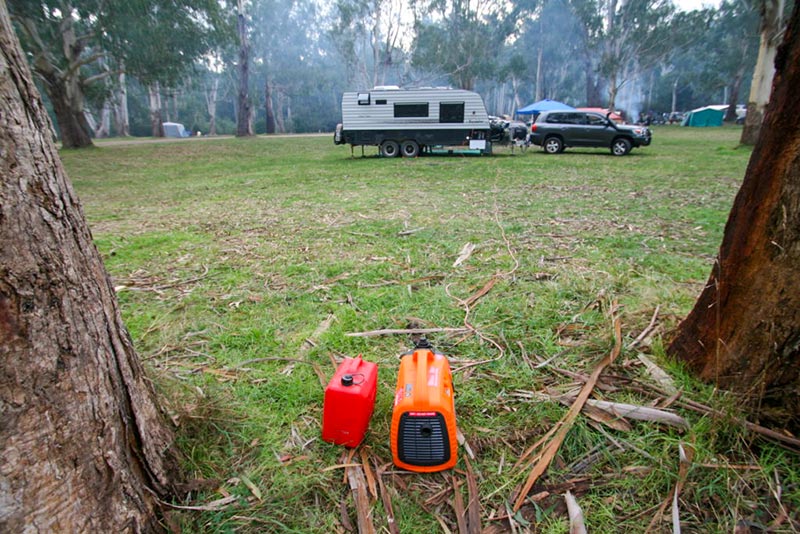
A very popular generator is the Honda EU22i, and it is often recommended as a good choice for powering a caravan. However, depending on your model of air-conditioner, it may not prove to be up to the task.
Again, looking at the specifications of the Honda, it has two power output ratings: Maximum AC Output = 2200VA (or 2.2kVA); and Rated (or Continuous) AC Output = 1800VA (or 1.8kVA)
The first thing you’ll notice is that the ratings are in VA or kVA. This stands for volt-amps or kilovolt-amps. Not watts. Now, I could go into a long-winded technical discussion about the difference between the two, but here’s the simplified explanation.
Volt-amps is the apparent power flowing through an electrical system, whereas watts is the real power or the power required for the appliance to do the work. The difference is called the power factor, and different types of appliances (or loads) will have a power factor, usually between 0.8 and one.
Your air-conditioner is essentially an electrical motor powering a compressor and a fan. Motors are inductive loads, so their power factor is generally around 0.8 or in the lower part of the range. To determine the required output of the generator, we multiply the power output rating in volt-amps by the power factor of 0.8.
So the actual wattage capacity of our Honda EU22i generator running inductive loads is as follows:
Maximum AC Output = 1760W (2200VA x 0.8); and
Rated (or Continuous) AC Output = 1440 watts (1800VA x 0.8).
The difference between the two ratings is important. The maximum output (sometimes called the peak output) is the maximum output the generator can sustain for a short period of time. The rated or continuous output is what the generator can sustain for an extended period of time. This is the figure we are most interested in.
In summary, the Honda will happily run the Truma Aventa Comfort, but it will struggle to power the Dometic Ibis and will likely not run it at all. If it does run, it will be working at its absolute maximum, potentially resulting in reduced life of the generator or even damaging the unit long-term.
BUT WAIT, THERE’S MORE
This is not the end of the issues you will need to deal with. When an electrical motor turns on, it draws a much larger, temporary current than the normal operating current. This causes the motor to use a lot more power than it would once it’s up and running. This is called the start-up load or in-rush current, and though it lasts for a short period of time, it can be as much as 10 times the normal operating current.
For the Truma Aventa, this start-up load is listed as 28A or 6720W! Admittedly, this is for a very brief 150 milliseconds, but that can be enough to trip the over-current protection of many generators, even ones with a higher capacity than the Honda.
The Dometic Ibis has a ‘soft start’ feature that gradually increases the power output, avoiding a sudden surge that might trip the generator’s overload protections.
Another issue to consider is the continuous operating hours of the generator, and this is a specification that is often hard to find. In the case of the Honda EU22i, generally considered the best quality generator on the market, this is just three hours at the continuous rated output. Run it for longer periods of time, and you risk damaging or shortening the life of the generator.
IF ALL ELSE FAILS
If after doing all this and ensuring your generator has the capacity to run your air-conditioner and it still fails to work, there are three likely causes:
- You have another appliance turned on, such as a hot water system, battery charger or other high-wattage device. Make sure you have all other 240V appliances switched off and try again.
- You need a new electrical cord between the generator and your caravan. I highly recommend you purchase a new, high quality extension lead no longer than 10m.
- The generator has a higher specification than what it is actually capable of delivering. This is very common with many cheap ‘no-name’ brands. Remember the adage ‘you get what you pay for’.
IS IT WORTH IT?
Now that you know how to size a generator to power your air-conditioner, you need to ask yourself, ‘Do I really need one?’
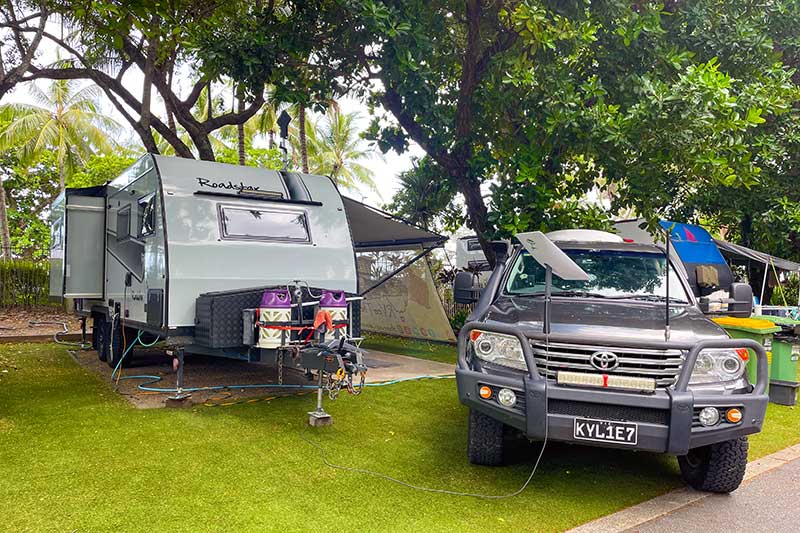
Consider that most generators will use about 1L of fuel per hour, sometimes more, depending on the load. If you want to run your air-conditioner all day, it will use at least 10L of fuel per day. So if you carry a 20L jerry can of fuel, you may have enough for two to three days of run time.
But let’s face it, who wants to listen to the drone of a generator running all day long? You will also need to consider that most public campgrounds have limits on when you can use a generator. Most will require you to turn it off after 6-8pm. I would argue that this is the time when you might actually want to run the generator and air-conditioner so you can cool down your caravan before going to bed.
Personally, I think if you are camping in really hot weather and you want to run your air-conditioner, you’re much better off checking into a caravan park and having access to all the electricity you can use.
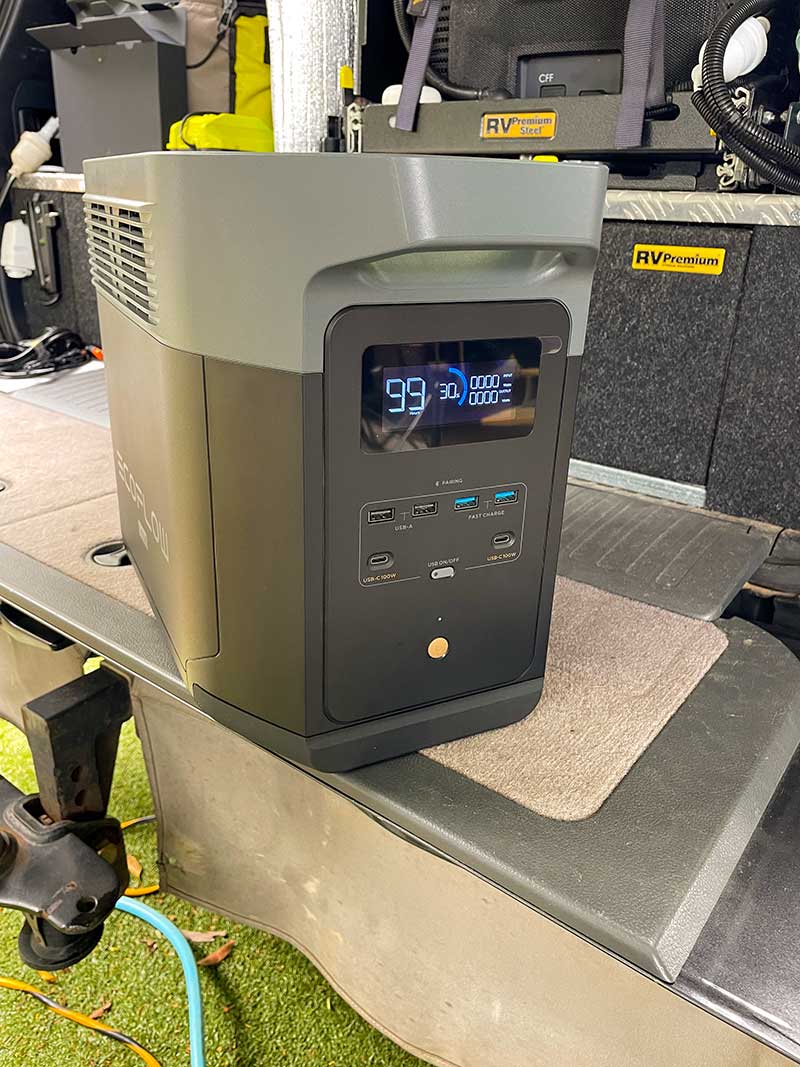
Alternatively, consider purchasing a portable lithium power pack (or solar generator). Suppose you have one of around 2000Wh capacity. In that case, you could run the Truma Aventa Comfort for about two hours (perhaps longer if you set the temperature a little higher) at night and cool your van down before you go to bed without disturbing your neighbours at the campground.