
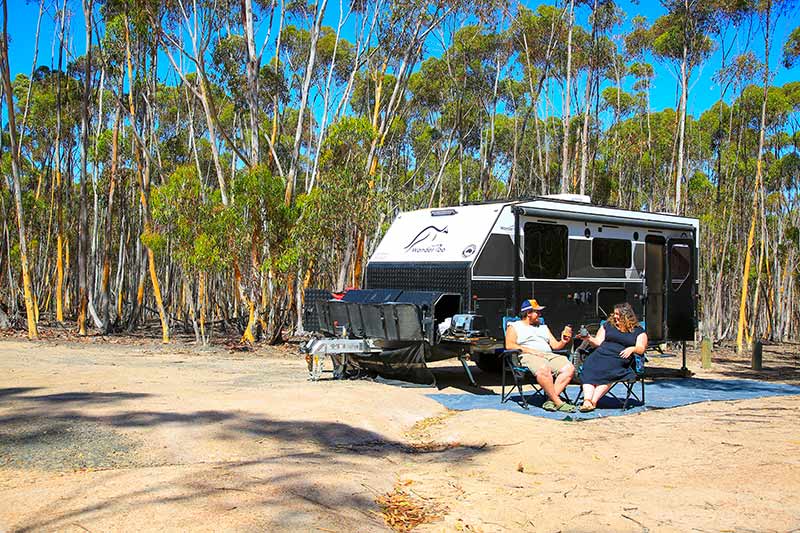
Is there anything more exciting than taking delivery of a new caravan? For Paul Sharman and his partner, Ellen MacDonald, hitching up their Wonder Roo EV Multi+, a 19ft 6in tandem-axle rig, it signified the beginning of a new era of adventures.
Towed behind their Ford Ranger, the EV Multi+ is a high-riding piece of equipment that means business. Paul and Ellen wanted a van that would never let them down, both from a mechanical and a power perspective.
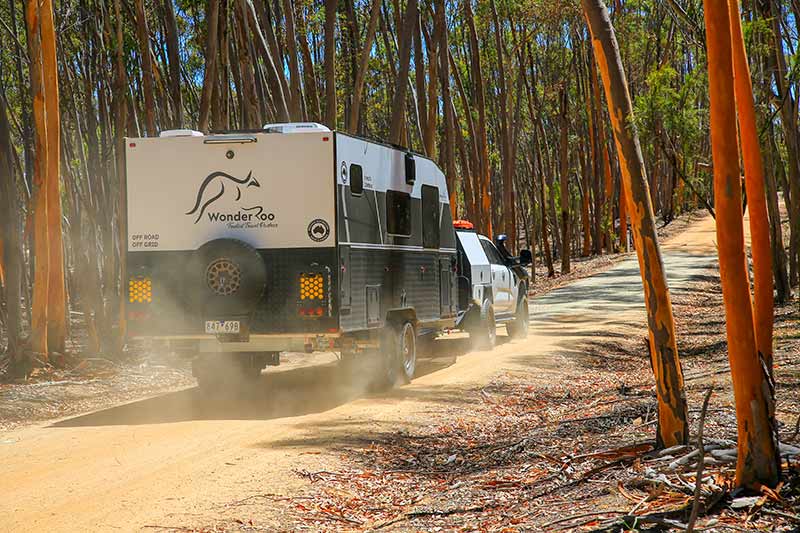 As you might have guessed, the ‘EV’ in this van’s name (‘electric vehicle’) refers to its substantial electrical system. As a result of their decisions and the work of Wonder Roo, it’s safe to say Paul and Ellen are unlikely to ever find themselves out of juice.
ALUMINIUM FOUNDATION
Let’s begin at the foundation. The EV Multi+ rides on a 170mm aluminium chassis with 170mm A-frame. The inhouse-built aluminium chassis is another feature that appealed to Paul. As a truck driver, all the tipper trailers he had towed were built on an aluminium chassis. As he says, if it’s good enough for a truck, it’s good enough for a caravan, and the weight savings of aluminium in comparison to steel were very appealing.
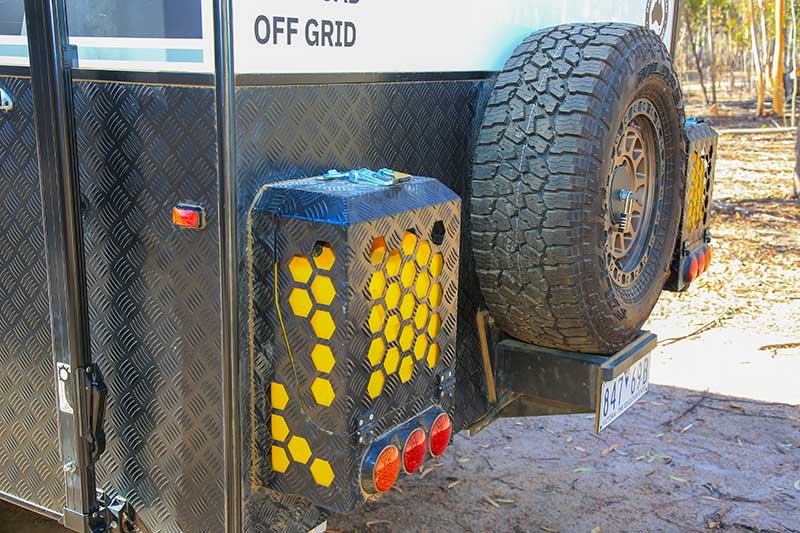 It’s fitted with Level 4 Cruisemaster ATX airbag suspension and BMPRO electronic sway control. Asked how it tows, Paul couldn’t be happier. The EV Multi+ tipped the scales at 2763kg Tare, with an ATM of 3500kg – both caravan and tow vehicle are a great match.
Wonder Roo has the ability to frame its vans in aluminium as well as build vans from fibreglass sandwich panels. Paul and Ellen opted for TIG-welded aluminium aluminium box-section studs, with a fibreglass-lined, TIG-welded, aluminium-framed roof, a ‘honeycomb’ flooring and acres of protective checkerplate. This is a substantial build.
 One of Wonder Roo’s hallmarks is how and where it locates much of the electrical equipment. If you look inside the tunnel boot on the nearside, you’ll find a 5000W inverter mounted behind vented Perspex to keep it protected, while the same material is found on the offside to protect fuses and other sensitive equipment. The rest of the electronics are housed within an offside compartment with a filtered air vent.
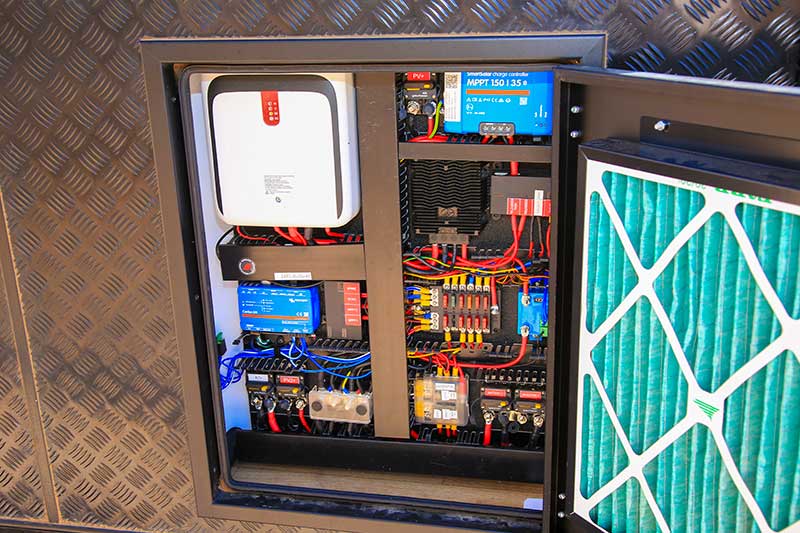 Now, this is in fact a 48V system. Paul in particular knew what he wanted, and understood the advantages of 48V in comparison to 12V. The wider Australian RV industry is still catching up in this respect, but Wonder Roo was on the case. The lithium battery system provides the equivalent of 864Ah, while on the roof there is a heroic 10000W of solar to charge the batteries via the 40A 48V solar regulator (equivalent to 160A 12V).
There are a host of advantages to running a 48V system over 12V, but the one that’s mostly applicable to vanners is the efficiency factor. Current is directly proportional to voltage and inversely proportional to resistance. So an increase in voltage increases the current (as long as the resistance is held constant).
We often talk about ‘off-grid’ caravans in relation to their electrical system but water is just as important. Without it, you could have all the juice in the world but you’d still be forced to pack up once the tanks were dry. Paul and Ellen, therefore, wisely had three 110L freshwater tanks fitted – one specifically for drinking water – as well as one 110L grey water tank. Yes, that’s potentially a lot of water weight, but if well managed, I see no issues.
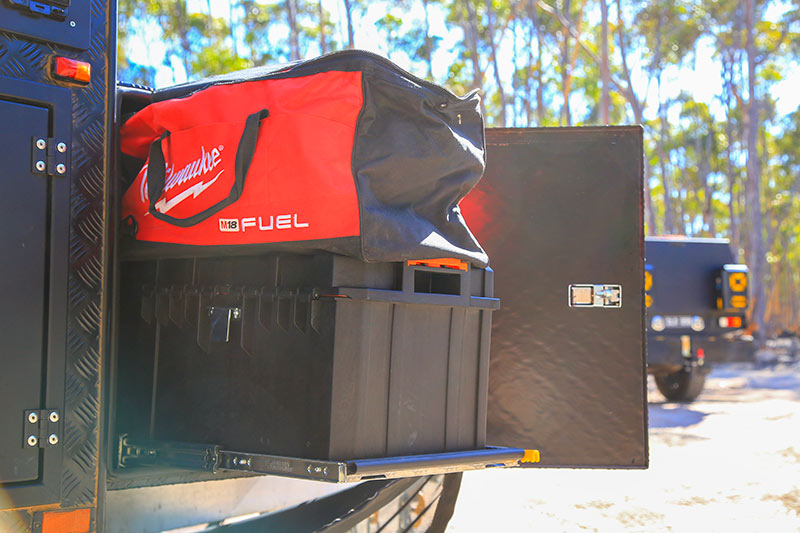 Obviously, it’s a gas-less caravan. The couple use their own portable induction hotplate when cooking inside, but otherwise it’s all about the electric Ninja Woodfire barbecue. Paul and Ellen love it. They’ve fitted it to the tray within the checkerplate toolbox on the A-frame – it simply plugs in.
While the van does have a mesh stoneguard on the A-frame, Paul also uses a Stone Stomper – invaluable protection for such a large financial investment.
THIS IS LIVING!
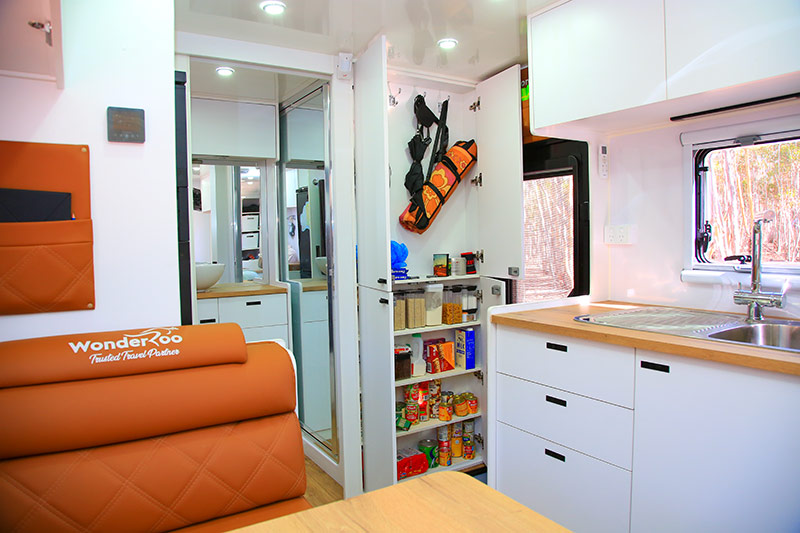
Stepping inside, I was greeted by a welcoming layout comprised of a forward bed, an offside L-shaped dinette, nearside kitchen and a bathroom in the back. The cabinetry throughout is done to a high standard, which is what we’d expect from Wonder Roo.
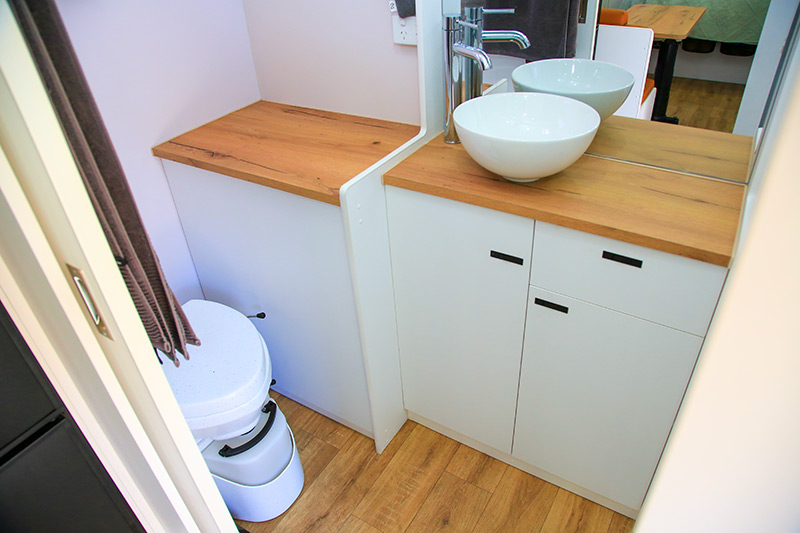
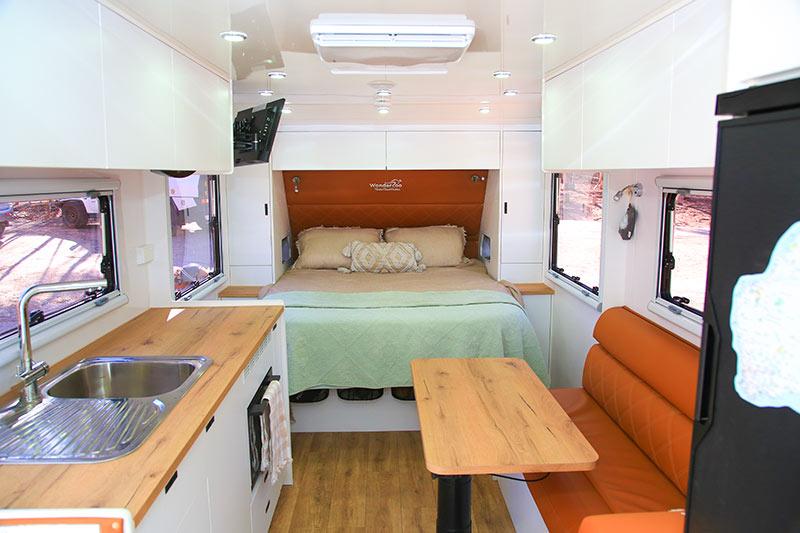 The fridge, which sits between the dinette and bathroom, is a substantial 175L compressor unit, while the reverse-cycle AC unit is no slouch either – a 3.5kW Gree that should have no issue cooling the van, whether off-grid or plugged into mains. Speaking of heating though, Paul and Ellen opted for the diesel-fired Eberspacher combo space and water heater. The composting toilet further adds to the true off-grid nature of this van.
The bathroom is a very attractive space. While it doesn’t contain a washing machine – a specific choice of Paul and Ellen – it does have all the essentials and it looks great.
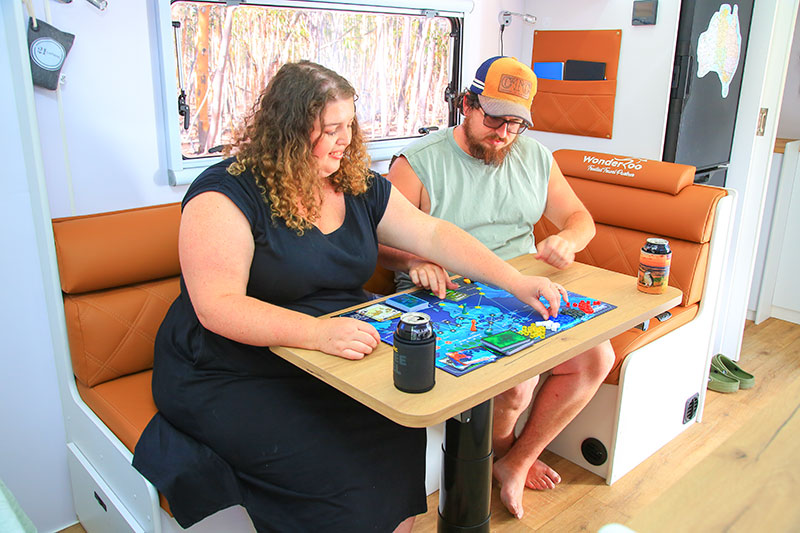 Asked to nominate their favourite features of their pride and joy, Ellen quickly pointed to the van’s overall comfort factor.
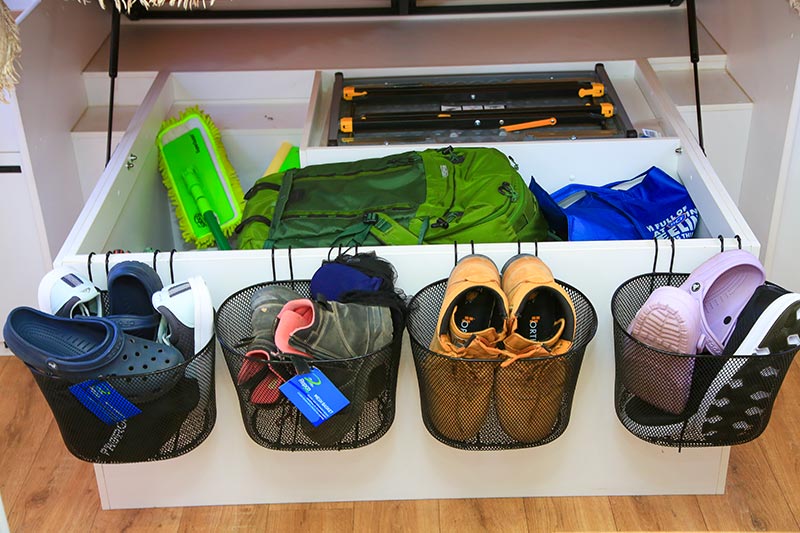
“We’ve cooked with the barbecue on, the air-con on, all the lights on, all at the same time, with no issue,” she said. “We can live off-grid all the time, as long as the sun is shining. I like the full-length bathroom mirror – it feels like luxury – and it feels like we have enough space and storage for anything we want to bring along.”
 For Paul, it’s all about the power system. Incidentally, the couple carries an additional 600W in portable solar panels, which combined with the rooftop solar, gives them a potential maximum of 1600W!
When it comes to their experience working with Wonder Roo, Paul had one word: “Unreal. Any questions, they were always available, and any little things I wanted to talk about or change, they were always happy to work with us.”
 Ellen agreed. “Because they are a family run company, you get to speak to the whole team and get to know everyone – it’s a very personal approach.”
These sentiments echo those of other Wonder Roo customers I’ve spoken with. Each has been thrilled with their van and even after a lengthy shakedown, they’ve had nothing but praise.
SUMMING UP
With its powerful 48V electrical system, decent water storage capacity, and an overall sense of strength and reliability, this Wonder Roo EV Multi+ is 19ft 6in of off-grid adventure.
 The open road calls, and Paul and Ellen have answered with enthusiasm. I have no doubt their van will prove to be a faithful companion for their travels around Australia, whether on the bitumen or off, in a holiday park or as far from civilisation as they can travel.
COMPLETE SPECS
Overall length: 8.5m
External body length: 6m
External width: 2.5m
Travel height: 3.2m
Internal height: 1.98m
Tare: 2763kg
GTM: 3250kg
ATM: 3500kg
Unladen ball weight: 186kg
Frame: TIG-welded luminium
Cladding: Composite aluminium with black checkerplate
Coupling: DO35
Chassis: 170mm Wonder Roo custom aluminium extrusion with 170mm Wonder Roo custom aluminium extrusion drawbar
Suspension: Cruisemaster Level 4 ATX
Brakes: 12in electric
Wheels: 16in alloy
Fresh water: 2x110L
Drinking water: 1x110L
Grey water: 1x110L
Shower: Yes
Awning: Manual wind-out
Battery: 864Ah equivalent 48V system with 5000W inverter, DC-DC charger and BMS
Solar: 1000W with 48V regulators
Air-conditioner: 3.5kW Gree reverse-cycle
Gas: Not applicable
Bike rack: No
Sway control: BMPRO
Cooking: Portable induction
Refrigeration: Thetford 175L compressor
Microwave: Yes
Shower: Hand-held
Heating: Diesel Eberspacher combo space/water heater
Toilet: Composting
Washing machine: No
Lighting: LED
Entertainment: 24in flatscreen TV with Furrion DV3300 Series sound system
None. Wonder Roo is a custom builder, and this van was built to the needs of Paul and Ellen
RRP: $165,900