

I’ve been writing about the Australian caravan industry and lifestyle for close to 20 years. In that time, I’ve seen them weather boom and bust cycles, financial crises, a pandemic and so much more.
Through it all, one fact has been made clear over and again: the caravan industry benefits from a built-in resilience to hard times. At our core, Australians are an adventurous lot, fortunate to live in a diverse country that can be explored on one one passport, with one currency. An entire continent, all to ourselves.
When the economic proverbial hits the fan, reminding us that life and money are never guaranteed, it spurs a desire to travel while we can. Some cash out their super to live the retirement of their dreams; others buy what they can afford. Zoom out, and I think you’ll find that what we really want to do is to see this storied land before it’s too late.
LARGER VANS PREFERRED?
A new report from the Caravan and Camping Industry Association of Australia, however, has revealed a mixed bag. On the one hand, overall production of RVs decreased, but visitation to caravan parks increased significantly in some areas.
Context matters a great deal. 2025 was a year of persistent cost-of-living pressures, meaning that discretionary spending was measured, despite an easing of interest rates. But the Caravan and Camping State of the Industry Report 2026 nonetheless details a pretty robust landscape under the circumstances. While outbound international travel grew by 11 per cent, the domestic visitor economy still recorded 17.3 million overnight trips, 57.9 million visitor nights and $12.6 billion in expenditure.
The number of RVs built locally or imported is also a key indicator of the health of the industry. For 2025, that number of locally-built vans reached 23,963, a 4.9 per cent decrease on 2024, though still 12 per cent above the 2019 pre-pandemic levels. In that sense, the industry views these 2025 numbers as a ‘settling’ of the post-covid boom when local manufacturing reached in the order of 30,000-plus units per year.
RV registrations in 2025 increased four per cent on 2024, with 937,701 vans registered in Australia overall, and then there’s the caravan parks. Economically, their performance improved by seven per cent, with total national revenue reaching $3.3 billion. New South Wales did particularly well, surpassing $1 billion in revenue for the first time.
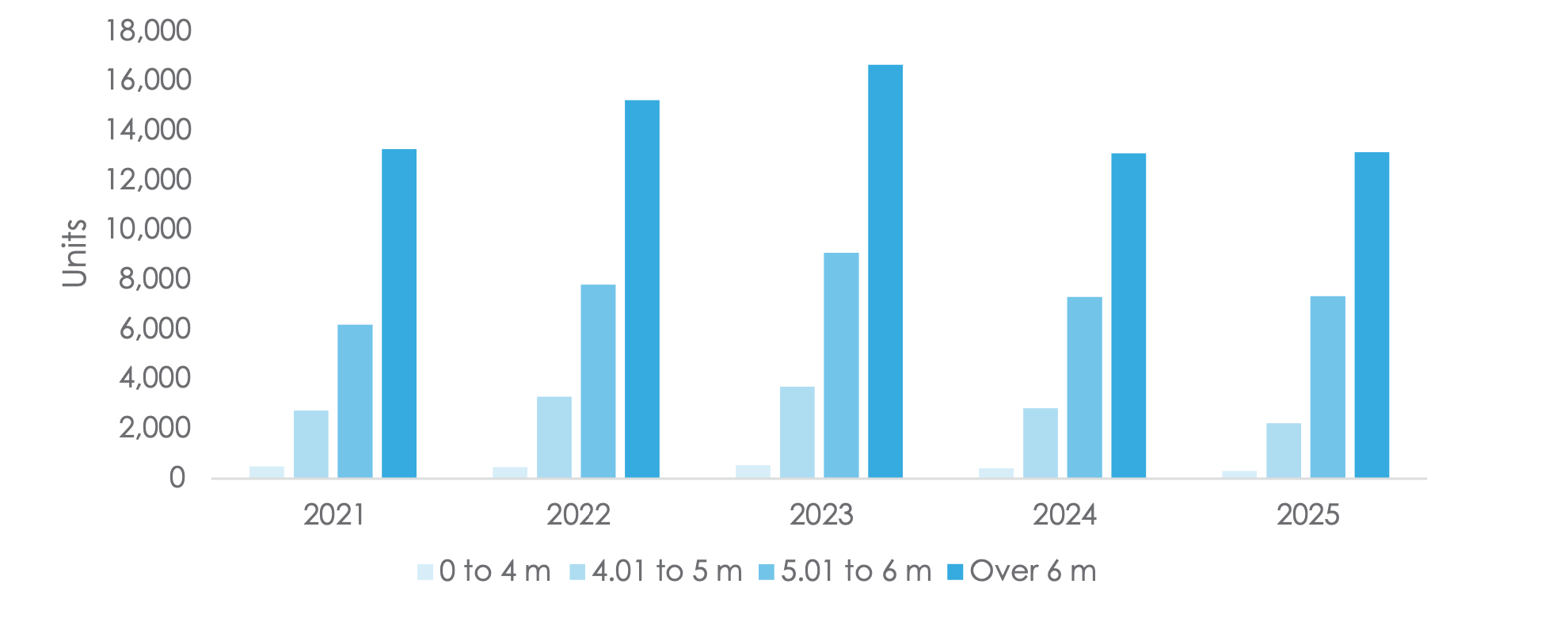
Interestingly, 2025 showed a distinct preference for larger caravans. Overall, Australians preference towable units next to motorhomes – which has long been born out in the data – but who would’ve thought that in a time of rising cost-of-living pressures that vans over 6m in length would reign supreme? Instinct tends to suggest the opposite – smaller, lighter vans are cheaper to buy (in general) and cheaper to tow (always). So what gives?
That’s something the report doesn’t go into, instead just providing the data, which showed that production of vans under 4m in length fell 27 per cent to just 305 units for the year. Vans from 4-5m in length also declined significantly, dropping 21 per cent to 2237 units.
But vans from 5-6m actually saw a one per cent increase on 2024 levels, as did vans over 6m. Both categories remain the dominant segment of the towable market.
MOTORHOMES
While towable largely RVs held their own in 2025, it’s a bleaker picture for motorised RVs – motorhomes. In fact, Australian manufacturers built only 910 vehicles in 2025, a sharp decrease on the previous year of 39.6 per cent or 597 fewer units.
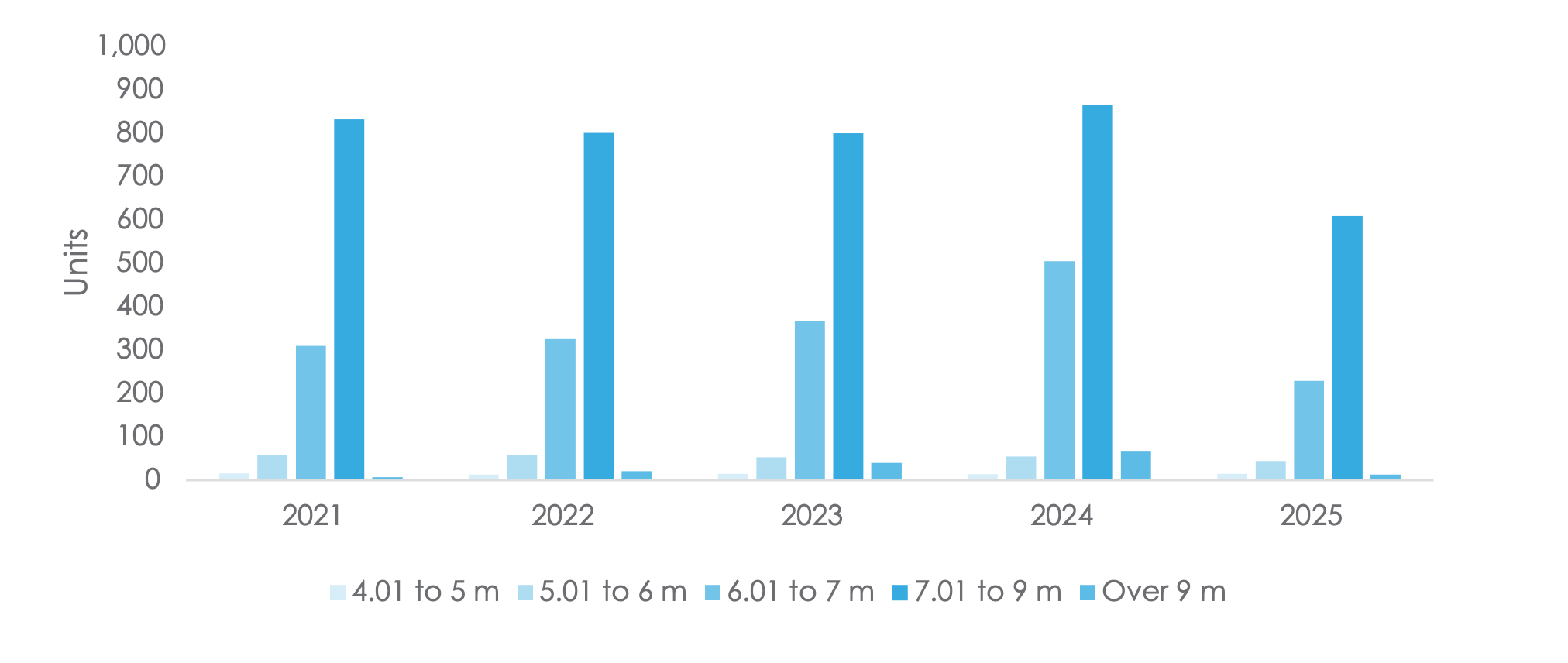
Most notably was the decline in campervan production with only 96 campervans sold. 2024 was a solid year for campervans, somewhat attributable to rental fleet restocking as international tourism recovered from covid, and the industry suspects an easing of that demand is somewhat responsible for those changed figures.
Motorhomes from 7-9m in length were the dominant sellers in this category but the most significant change occurred in the 6-7m range, with production falling 55 per cent to 229 units following a 2024 increase of 38 per cent.
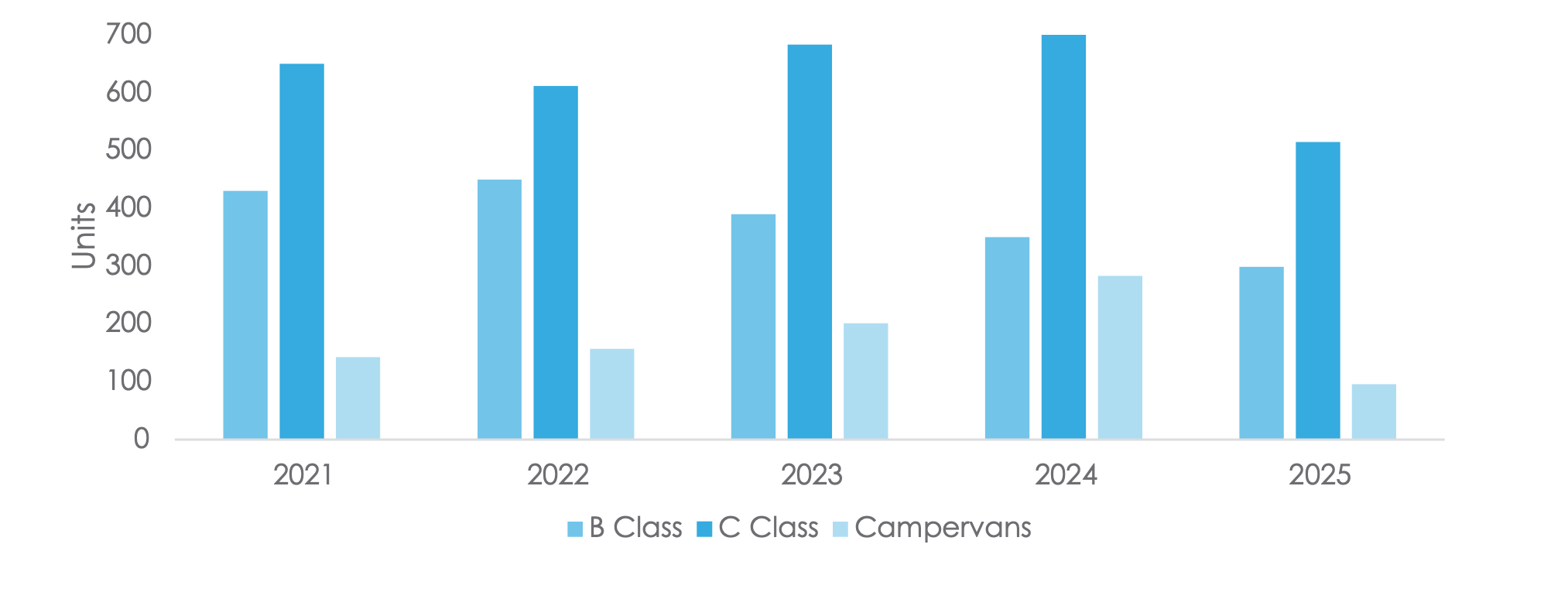
Motorhomes over 9m in length experienced the sharpest decline, falling 81 per cent to just 13 units for the year.
IMPORTS
This is, obviously, a huge section of the market, in particular vans built in China for our shores. According to the report, a total of 23,244 vans and related components (the vast majority from China) were imported for sale here. In comparison to 2024, that figure represents a 16 per cent increase to 3251 units.
Interestingly, the Freight on Board metric, which quantifies the value of the imports, rose to $619.2 million, an increase of 12.6 per cent.
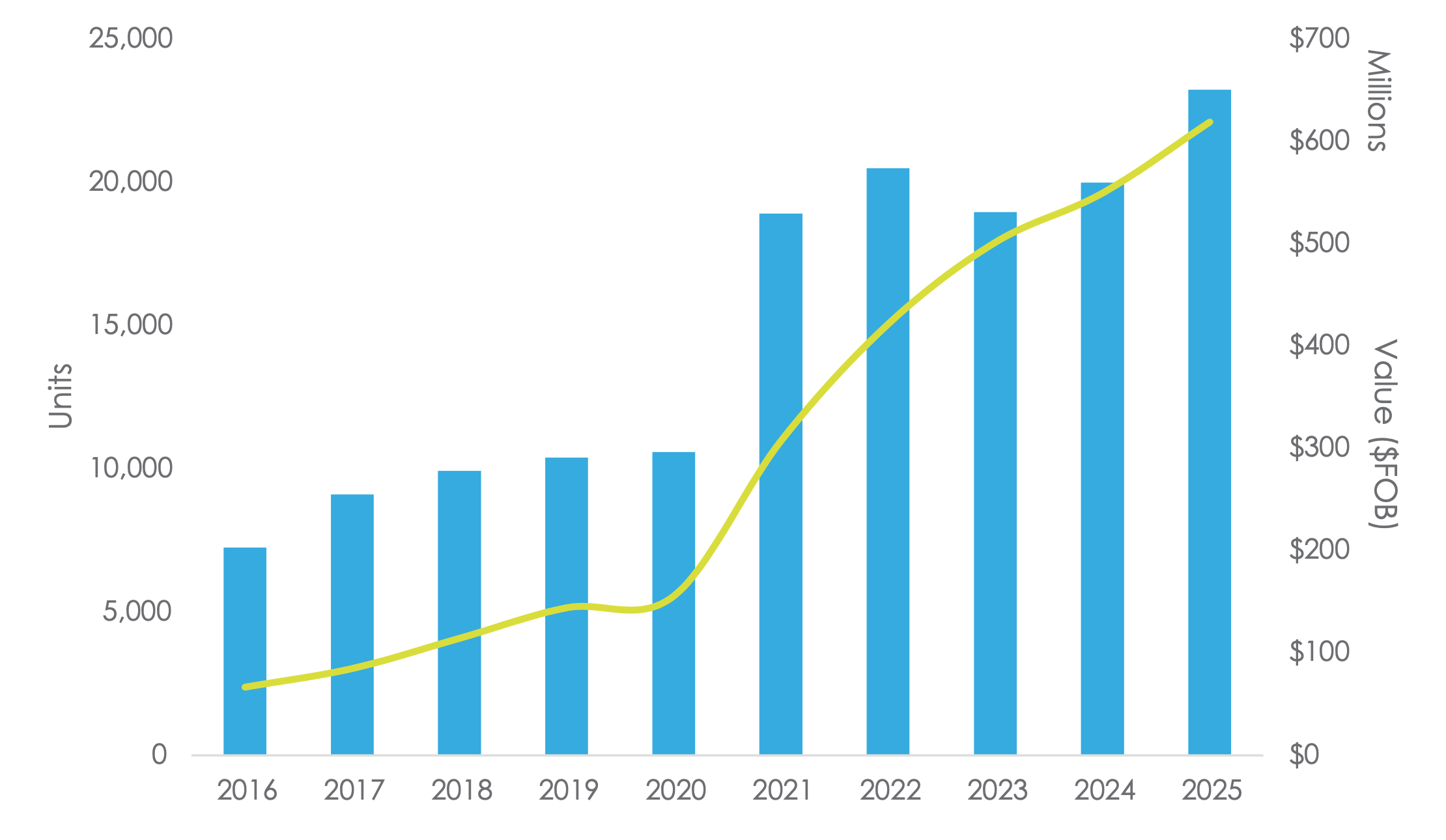
But how to square the difference in value growth with the growth in actual units? According to the report, this difference reflects the fact that consumers are voting with their wallets in this segment, with an average unit price is $26,638. This is a modest decrease in average price from the previous year ($27,494).
Perhaps unsurprisingly, Queensland received the highest number of imports by a wide margin: 11,525 units or 50 per cent of all RV imports (a 40 per cent increase) while Victoria came in second place with a 33 per cent market share.
BY THE NUMBERS
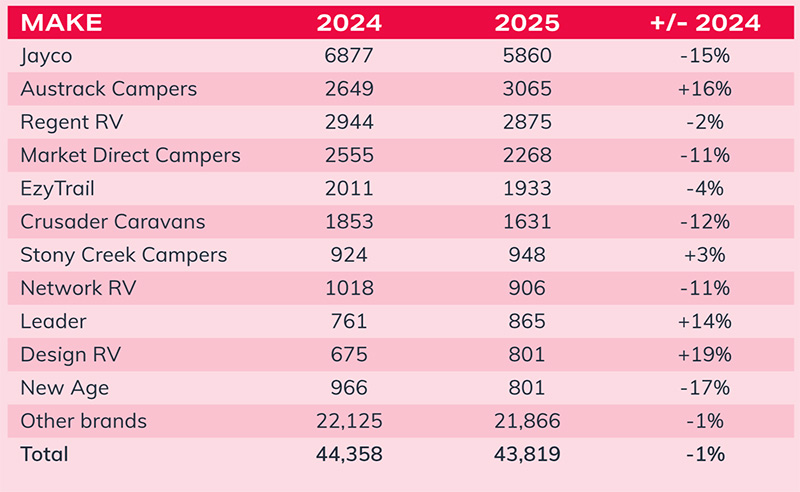
Each vehicle built here or imported is listed on the Register of Approved Vehicles and approved under the RVSA legislation. As such, it provides a pretty good indication of production by manufacturer (though the industry cautions it shouldn’t be used as the sole determiner of market share).
As we can see in the following table, which is populated by RAV data, Jayco retained its lead, despite a 15 per cent drop in production. We can also see Austrack (whose vans are manufactured in China), moving ahead in leaps and bounds, while Regent RV (Snowy River), EzyTrail and MDC maintain a healthy lead over local competition.
As a side note, when I started this caper 20 years ago, I would’ve laughed if you’d told me that one day, the import market would be nipping at the heels of local manufacturers, such was the parochialism of the time. But here we are, with vans built overseas not just nipping at the heels but outpacing local manufacturing. China can do it cheaper and people will always prize value. Capitalism and globalism in a nutshell.
CARAVAN INDUSTRY: THE WASH-UP
Anecdotally, 2025 was a tough year for a lot of operators in the caravan industry, and 2026 has only proven to be more difficult. Yet, this report indicates that – from a wider perspective – interest in the lifestyle did not wane. People were still buying caravans, holiday parks were still bustling, and tourism dollars still flowed to regional communities.
As we know, Iran’s throttling of a large portion of the world’s oil supply has thrown a spanner in the works this year, increasing the cost per kilometre of travel, causing people to redirect their holidays locally or to cancel them for fear they’ll become stranded. While fuel for now seems stable and the price per litre has fallen, we’re a long way from being out of the woods. Further, confidence is in short supply, considering who’s in charge: one an irrational narcissist who may or may not be suffering from dementia, the other a madman who has wanted this war for longer than I’ve been writing about caravans.
And yet… the hunger for our way of life endures. It can be witnessed at regional caravan shows, which continue to be well attended, or in holiday parks around the country. Pockets of the industry have suffered, while others have had to adjust to remain viable, and others have failed by the wayside entirely.
But the numbers indicate resilience. As I said at the beginning of this screed, when the economic chips are down, Australians extend a metaphorical middle finger. We understand we have the best backyard of all, and that we only get one life with which to explore it.