
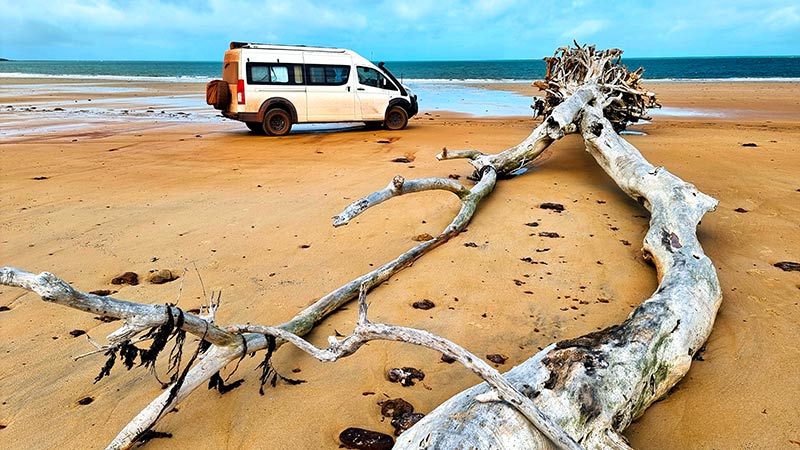
Ah, FNQ. Beautiful one day, perfect the next.
The beaches: pristine waters, soft sands, warm temperatures, remoteness, and the lack of crowds make the plentiful beaches of FNQ the perfect coastal getaway.
I set about discovering the top beaches north of Cairns, well, except one that’s south because it was too good to miss, all in the name of research… well, living it up on my way to the tip of Australia, Cape York.
Working from Bingil Bay to Cairns, then right up to Cape York at the tip of Australia, read on for some of the best that FNQ has to offer, keeping in mind that we tried to stay away from the well-known, touristy, crowded beaches of the area. Yes, there were many other beaches, large and small, in the region, so go forth, seek them out, and enjoy them on your trip north.
BINGIL BAY
Bingil Bay is south of Cairns by about 140km, just shy of a two-hour drive along the FNQ coast, and just north of the more well-known and popular Mission Beach on the Cassowary Coast section. The spacious, shaded campsites are to be pre-booked. An amenities block offers showers, toilets and a small cooking section. There is a day-use area with limited parking.
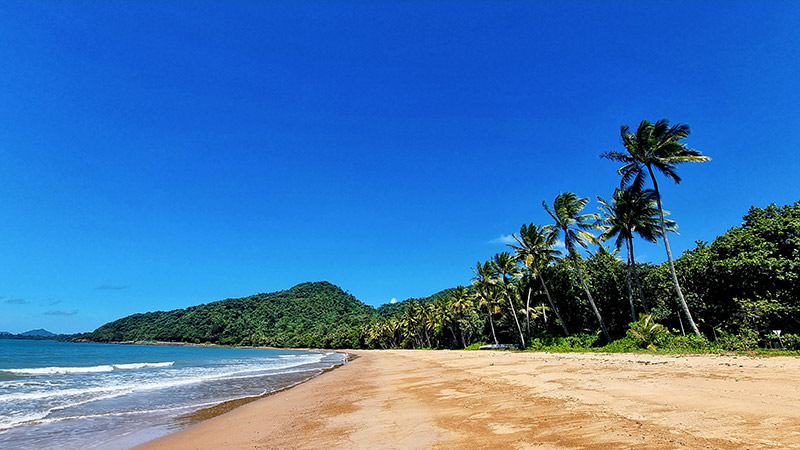 The beach is a beautiful, long, curved coastline lined with magnificent palm trees, the stuff of many a social media photo. Keep an eye out in the surrounding area for cassowaries. The Bingil Bay Café is a short stroll up the road; there are few other facilities in these parts.
THORNTON BEACH
Thornton Beach, or North Thornton Beach, is a little different to most beaches and lies about 130km north of Cairns, a good 2.5-hour drive. Well, it’s a lot different!
There is no sand here, and it’s hard to find because of the lack of signage and information. From the northern end of the sandy section of Thornton Beach, you’ll have to walk along the Cape Tribulation Road for a few hundred meters. The track down to the rocky beach is hard to spot and partially overgrown, with little to no maintenance.
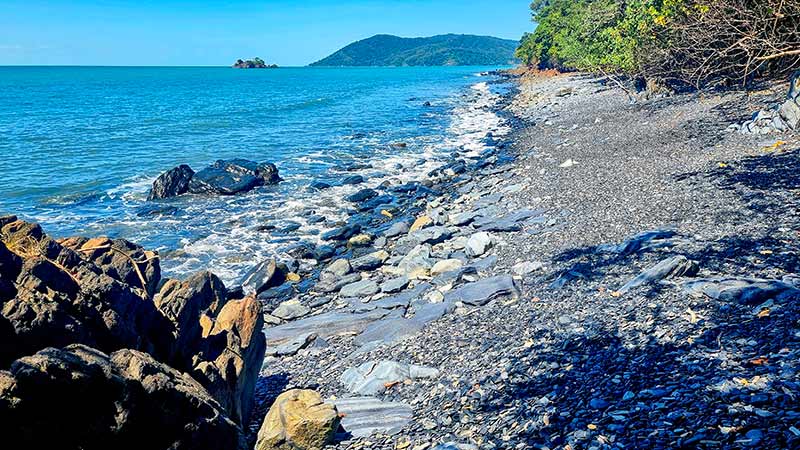 Once on the rock-strewn beach, picking up and throwing (carefully) a handful of rocks, you’ll be amazed at the way they bounce and scatter, just like good ol’ super balls. Tossing the rocks will see them striking larger variants, with seemingly supernatural bouncing powers. Do be careful, as the hard, dense, black, volcanic stones can bounce, ricochet and rocket in all directions.
CAPE TRIBULATION
A further 20km north, now up to 140km from Cairns and just under a three-hour drive, is the well-known Cape Tribulation, which is the world heritage-listed Daintree National Park.
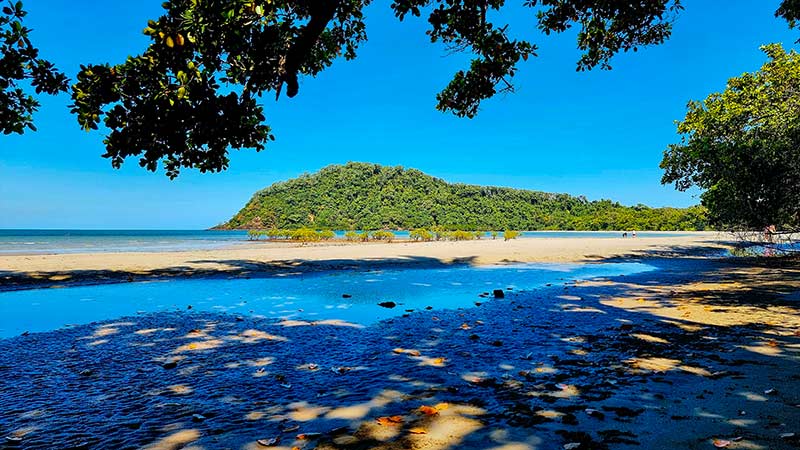 This beach is still easily accessible by road, south of the more adventurous 4WD sections of the coastline. The Bloomfield Track is the closest section, leading further north to Cooktown.
Given its popularity, there is a host of eco-style tours and accommodation in the area. While you can’t swim here (see separate section on why), Masons Swimming Hole (and café) is quite close and a perfect spot for a croc-free dip.
MYALL BEACH
Just north of Cape Tribulation is Myall Beach, which, in my opinion, is more worth visiting for its pristine beauty. Walking to the northern end of the beach, there is a rock-scrambling hike along the rugged coastline, which offers brilliant vistas over the whole bay. We spotted turtles and a dugong from this vantage point, and spent over an hour sitting, watching, dreaming, and solving not a single one of the world’s problems.
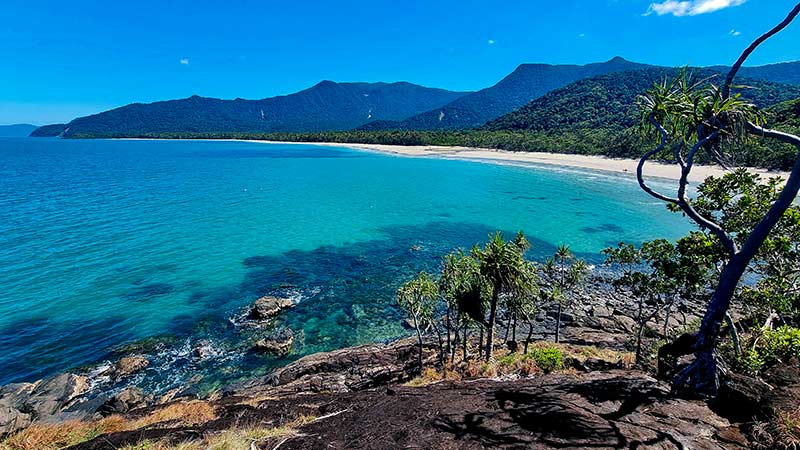 Boardwalks take you from car parking areas to the beach, on which you are free to roam its entire length, fringed with swaying palm trees.
Cassowary sightings are a regular occurrence. Keep an eye out and beware of their dangers.
COWIE BEACH
Another 12km north of Myall Beach is Cowie Beach. The flat-surfaced beach, together with larger tidal movements, will decide how much sand you’ll see here. At low tide, it’s a fair walk out to the water’s edge with many a strange and intriguingly-shaped mangrove and root systems at which to marvel.
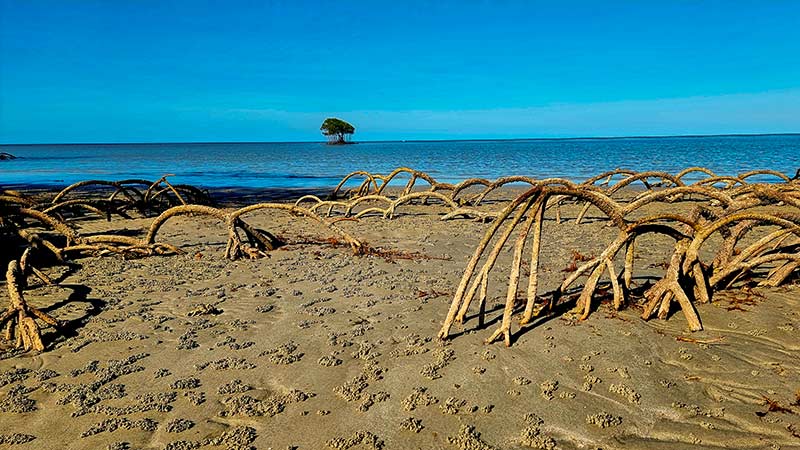 The single, distant mangrove, set in the ocean’s waters full-time, is a particular standout and well-photographed phenomenon.
Still part of the Daintree National Park, this beach is south of the magnificent Wujal Wujal waterfall, on the Bloomfield Track, which weaves its way north along the coast, eventually towards Cape York.
FINCH BAY
Finch Bay is a part of the coastal town of Cooktown, a place not to be missed for its history, fishing, exploration and quirkiness.
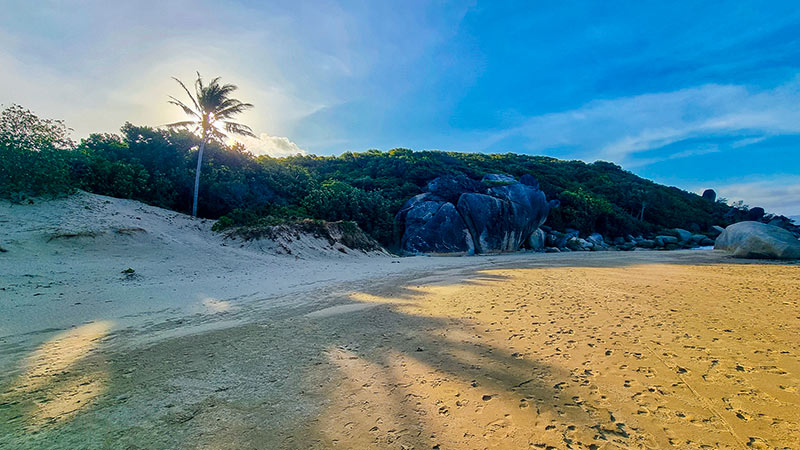 We stayed in Cooktown, with a day visit to the botanic gardens, from which a well-signposted bush track takes you to the beach. Further walks lead to Cherry Tree Bay and then up to the headland’s lookout. However, we spent a few hours taking in the natural beauty of the rock formations, sand and river inlets. We wondered how many crocodiles might be watching us from amongst the mangroves.
Cooktown is not to be missed on your way north, with the ability to stock-up on everything needed for further adventures, as well as a few great caravan parks.
ELIM BEACH
The coloured sands of Elim Beach are not to be missed. They rival that of Rainbow Beach, near Fraser Island, for colour variance, vibrance and range along the couple of kilometres of coastline.
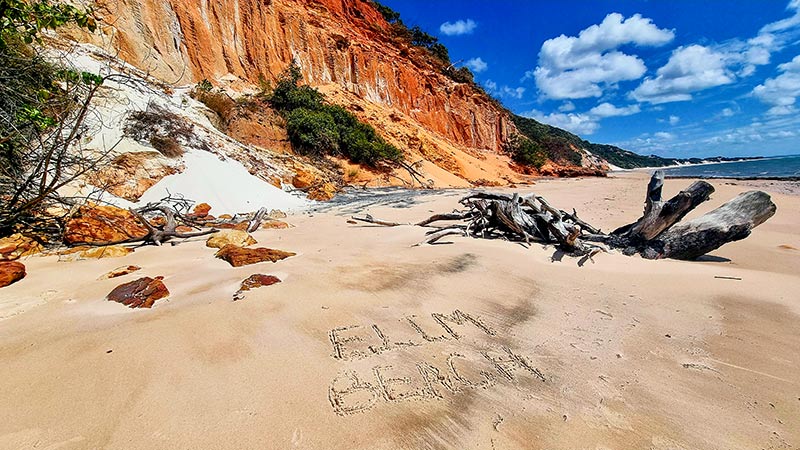 While we didn’t drive on the beach because the tide was too high, it is possible to take your 4WD on the beach at lower tides. We spent a couple of hours wandering the coastline, marvelling at the high colour dunes sweeping around the remote beach.
The remains of one poor soul’s 4WD, which we spotted rusting away on the beach, serves as a reminder of what can go wrong while driving on our beaches.
The Elim Beach Campground, or Eddie’s Camp, is about a 15-minute drive away and offers unpowered beachside camping, as well as shaded sites set back in the shade. An amenities block provides showers and toilets, and there’s a basic camp kitchen to wash dishes and yarn with other travellers.
Cape Bedford is another place worth visiting while camped at Eddies, though some serious 4WDing is required to get here.
FIVE BEACHES DRIVE
Beach-driving doesn’t get much further north on our continent than this, being just 10km south of Cape York and south of Somerset Beach Camp and lookout. The Five Beaches Drive comprises six, seven and eight beaches! Yep, these extra beaches at the southern end are much harder to reach, and most people are content with the five.
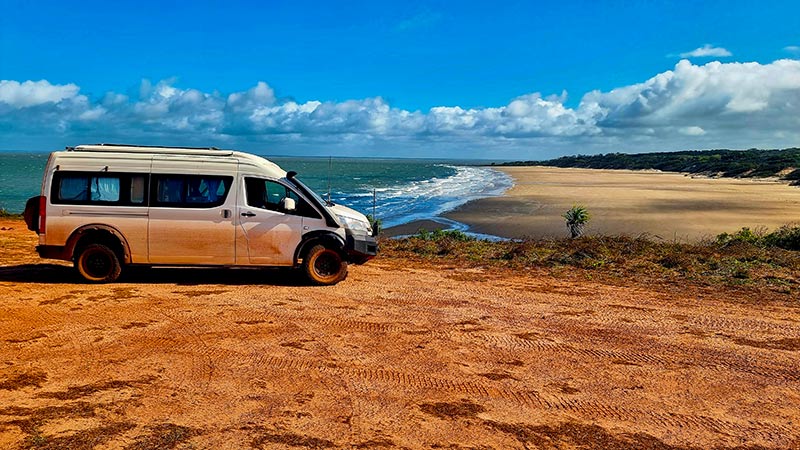 Essentially, you drive along the coastline, skipping between beaches and rocky headlands, often lined with magical deep red dirt, and Pandanus Palms, with a backdrop of deep blue oceans. Entry and exit to each beach are relatively straightforward, though tides should be noted to avoid getting caught in high water.
Fishing, so long as the trade winds are not howling, is on the money up here, but those winds blow more often than not. Basic bush camping is available en route, with no amenities. This is remote country, where a 4WD is mandatory. Being totally self-sufficient is paramount, so ensure you have the experience and abilities to tackle this amazing countryside.
MARK’S WISE WORDS ABOUT FNQ
Regardless of whether there are crocodile warning signs, I recommend that you do not swim in any of these or nearby beaches in FNQ. It’s an unfortunate position to be in; staring at the warm blue waters of a tropical beach as you wriggle your toes in the soft white sands on a hot, humid day, but not being safe to take the plunge for fear of being bitten or eaten by a Crocodylus porosus. That’s a saltwater crocodile, or salty in case you’re not sure.
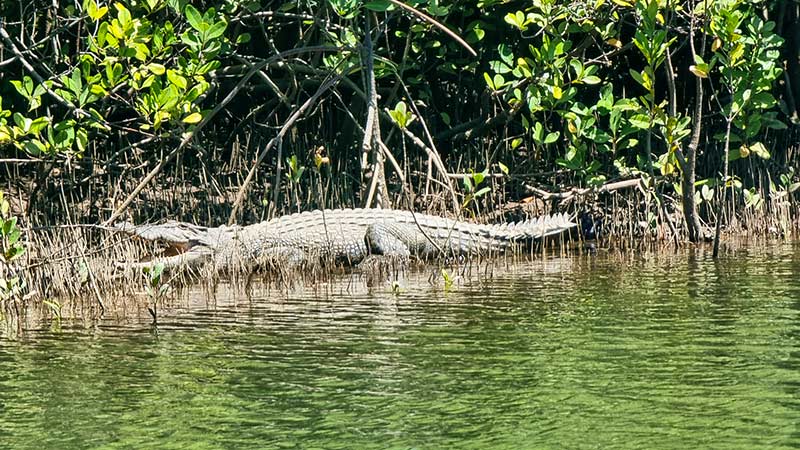 Then there are the sharks, box jelly fish, blue bottle and irukandji, blue-ringed octopus, cone snails, sea snakes and stonefish; any of which would turn your dream holiday into a nightmare.
While you’d be forgiven for wanting to choose somewhere far, far away from FNQ to holiday in, I still highly recommend visiting this stunning region of Australia. Just don’t swim in it. Or stand too close to the water’s edge…